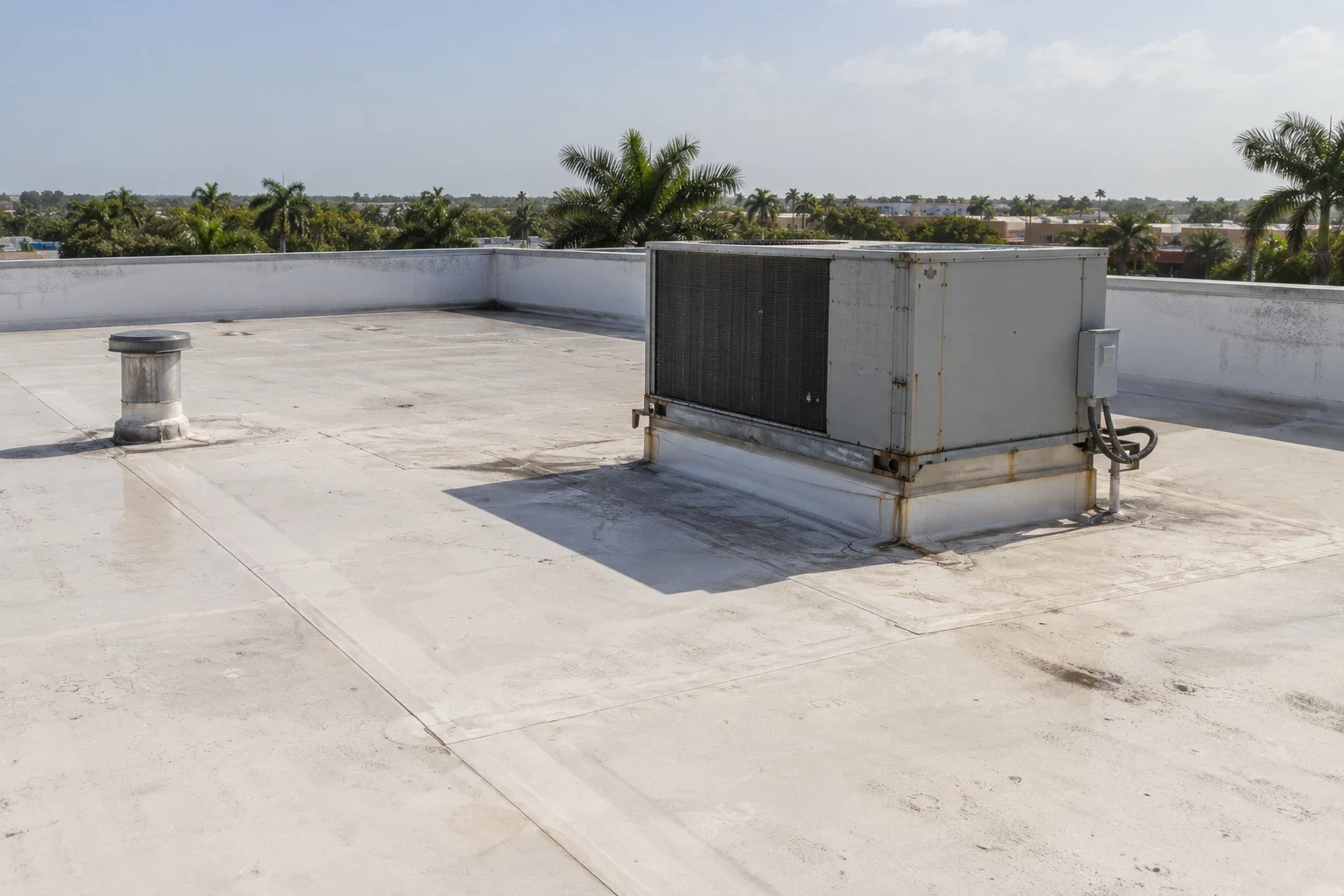
Duro-Last Roofing in Pembroke Pines, FL
Duro-Last prefabricated PVC roofs in Pembroke Pines, FL: panel seam checks, fabricated flashing repair, wet-season sequencing and HVHZ documentation.
A Duro-Last roof arrives as prefabricated PVC panels, cut and welded to the dimensions of the building, and that origin changes what an inspection finding means. Most seams are welded before the sheet leaves the shop, so the field seams where panels meet, and the fabricated flashing pieces at curbs and pipes, carry the repair risk. In Pembroke Pines, FL, we start by locating those joints, probing them, checking the fasteners and plates that hold the panels and surveying for affected insulation before an asset manager decides on capital work.
Locate the field seams first
A prefabricated roof concentrates its risk in the places where factory work stops. Panel-to-panel seams are made on the roof, so we find each one, probe its full length and photograph any gap against the roof plan. Boots, corners and curb wraps arrive as formed pieces, and we check that each is welded to the field sheet with enough overlap and that its edge has not lifted.
Fasteners and plates sit along the panel edges. A backed-out fastener lifts the sheet into a bump, and a row of them points to a deck or insulation problem. We mark each, test pull-out resistance where the deck allows and record the result.
Decide whether a fabricated piece can be replaced
The repair question is whether the damaged piece can be replaced or the surrounding sheet must be cut back. A cracked boot can often be removed and a new one welded on, provided the field sheet still fuses. A shrunken wrap at a curb may require a new fabricated piece cut to the measured dimensions, which takes lead time that belongs in the schedule. We take measurements and photographs on the first visit so replacement pieces can be made without a second trip. Measurements include curb height, pipe diameter and the distance to the nearest seam, since a piece that is a quarter inch short will not tie.
Moisture sets the second boundary. Infrared scans and selective openings find affected insulation, and the area is drawn on the roof plan. If the sheet welds and the boards are dry, the repair stays local. If wet insulation appears in separate zones, the larger package is the more defensible decision, and the report shows why.
Repair with measured pieces and tested welds
The repair sequence follows the lead time. Measurements go first, then temporary protection if water is entering. Affected insulation within the boundary comes out, the deck is checked, and new boards are installed at the original thickness. The new membrane piece is positioned, welded to the field sheet with hot air, probed and tied into the flashing. Terminations are re-secured and sealed, and the drain, if involved, is checked for a smooth turn into the bowl.
On a prefabricated roof, a new piece must match the sheet it joins. We confirm thickness, color and reinforcement before welding, and we try a test weld on a scrap of the retained membrane to confirm it can still fuse. A brittle sheet will not weld, and the boundary moves outward to sound material.
Weigh repair, recover and replacement
A local repair suits a sheet that still welds and insulation that is dry. A recover over a dry roof saves tear-off but adds weight and changes flashing heights. Replacement removes saturated material, re-engineers the attachment and resets the system. A new prefabricated roof needs accurate field dimensions, so the measuring step is part of the schedule, and a change in curb or equipment locations after measurement can force new panels. PVC chemistry itself resists many fats and oils, which suits roofs below kitchen exhaust, and the quote states the consequences of each option.
Map the wet insulation before ordering pieces
Water that enters at a fabricated flashing travels through the insulation, so the stain below is not the repair location. We survey the whole roof zone with infrared at a time of day when wet boards hold heat, confirm the readings with a moisture meter and open a few test cuts that are sealed the same day. The result is a boundary on the roof plan, and the order for new pieces follows it, so fabricated parts are not made for an area that will be cut out.
Boards inside the boundary come out and go straight into containers, so they do not soak the roof again. Replacement boards match the original thickness and are fastened to the design pattern, with joints staggered. Where the roof has been recovered before, we record the number of layers at each opening and flag any place where an older layer may hold moisture beneath a newer surface.
The readings at each test point go into the report, which lets a later survey show whether the wet area has grown, shrunk or held steady. That comparison tells the asset manager whether the repair worked and how much service life the roof has left.
Plan around hurricane-zone rules and the wet season
Local wind design starts from Exposure C unless Exposure D applies under ASCE 7-22, and prefabricated sheets here are installed under the 2023 code edition within the High Velocity Hurricane Zone. Three documents recur in local reroof permits: a zone reroof statement, an insulation certification and a rooftop equipment form. Fastener spacing, plate type and perimeter details are reviewed against the design professional's wind assumptions.
Rain is routine between mid-May and mid-October, and tropical systems become the larger concern from August through October. Prefabricated panels can be laid quickly once on site, but the roof still opens in bays that can be closed before storms. We check the forecast through the morning, stop opening new areas by early afternoon, and finish each day with a walk of every edge, seam and penetration, photographing the closed areas so the record shows the roof was sealed before the crew left.
Stage work in Hialeah and the surrounding cities
Hialeah identifies manufacturing, retail and restaurants as major parts of its economy and has access to I-75, the Palmetto Expressway, the Florida Turnpike and US 27. Hialeah Gardens reports $70.164 million in 2022 transportation and warehousing receipts, dated citywide context and not a building inventory. Those profiles guide access planning, such as truck routes and dock use, while the roof itself is identified on site. Stored goods, conveyors and sensitive equipment below the work zone are covered or moved with the tenant, and the lift position is chosen so trucks can still reach the docks. A Sika Sarnafil or Versico PVC roof gets the same seam and fastener review.
Commercial Roofing Questions
Why do prefabricated PVC roofs leak at boots and corners?
Formed pieces carry the most seams in the smallest area. If a weld is cold or the piece has shrunk, water finds the gap. We probe each weld and replace the piece when repair would not hold.
How long does a replacement flashing piece take?
Lead time depends on fabrication. We measure and photograph the detail on the first visit, place temporary protection if needed, and schedule the permanent repair around the delivery.
Can a prefabricated roof be recoated?
A clean, well-bonded PVC surface may accept a coating, but plasticizer and residue can interfere with adhesion. We test a patch before recommending it.
Does grease from restaurant exhaust harm the membrane?
PVC resists many fats and oils better than some membranes, but residue should still be washed away and the seams nearest the exhaust checked. We advise on containment where discharge lands on the roof.
How do you handle wind uplift concerns?
We review fastener spacing, plates and perimeter details against the design assumptions for the hurricane zone, and restore any attachment that has loosened or corroded.