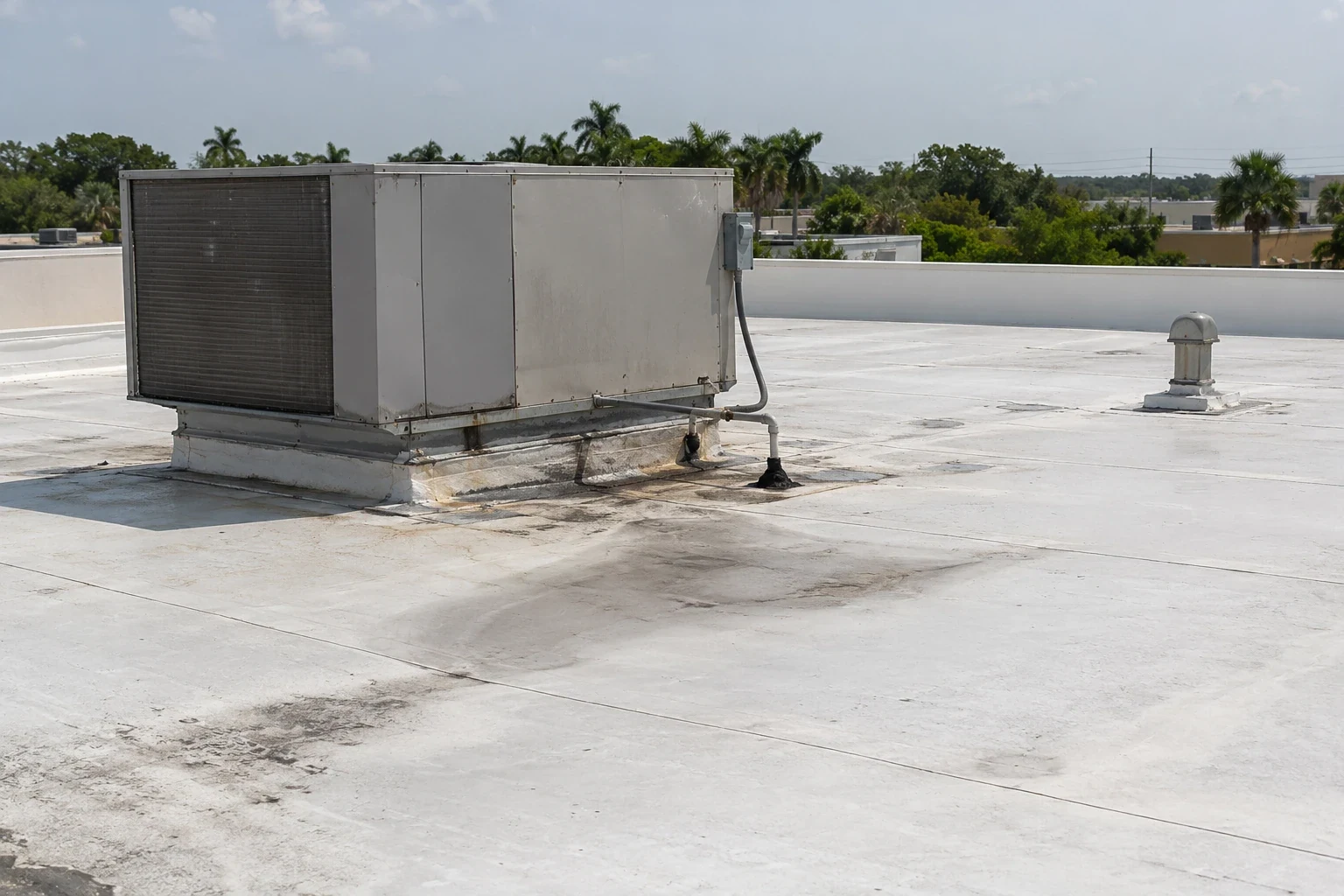
Johns Manville Roofing in Pembroke Pines, FL
Johns Manville commercial roofing in Pembroke Pines, FL: built-up, modified bitumen and single-ply repair, polyiso moisture checks and phased reroofing.
Water trapped between the plies of an older built-up roof can sit unseen for years, and a Johns Manville name on the plan does not tell an asset manager how many plies remain or whether they are dry. Johns Manville has a long record in built-up and modified bitumen roofing and also supplies TPO, EPDM and PVC single-ply membranes, with polyisocyanurate insulation beneath them. In Pembroke Pines, FL, the inspection finding that matters is the combination: which membrane, how many plies, what insulation, and how much of it is affected by moisture.
Count the plies and test the insulation
On a layered roof the first measurement is depth. We cut a small core, count the plies, note the asphalt between them and check whether the lower felts are damp. The sample is patched the same day and the location is marked on the roof plan. On a single-ply roof the equivalent step is a test opening that exposes the insulation, so we can read its type, its thickness and the way it is attached.
Polyisocyanurate boards can hold moisture at joints and at the facers, and wet boards lose both strength and insulating value. An infrared survey followed by moisture meter readings maps the affected area, and the map becomes the removal boundary. Findings are photographed in position so a later inspection can compare them directly.
Decide what stays on the deck
Retention is the budget question. A layered roof with dry lower plies and local surface damage may accept a repair or a coating once seams and flashings are sound. A roof with saturated plies cannot hold a new surface, and a recover over it would trap the moisture. The inspection report states which case applies, and it names the material that remains suitable to retain.
For single-ply roofs the same reasoning applies to the insulation and the cover board. If the membrane welds or bonds and the boards below are dry, a local repair is defensible. If wet insulation appears in separate areas, the capital work moves to a larger package, and the report shows the evidence for that step.
Repair from the deck up
A repair on a Johns Manville layered roof starts by cutting back to sound plies. Wet felts and affected insulation are removed within the boundary, the deck is checked, new insulation is installed flush with the existing surface, and plies are rebuilt in the order they were laid, with laps staggered. Flashing plies and cap sheets are tied in with a measured overlap, and granules or a coating protect the new surface from sun.
On a thermoplastic or rubber single-ply, the sequence follows the seam type: weld or bond, probe, then re-form flashings. For either construction we use the built-up roofing, modified bitumen or EPDM practices that match the existing roof, and we avoid mixing materials at a transition unless compatibility is confirmed. Where a repair must join two different materials, a transition detail is drawn on the roof plan, tested for adhesion where the product allows, and photographed before it is covered.
Compare repair, recover and replacement
Each path has a consequence that belongs in the quote. A repair inside a removal boundary keeps the rest of the roof in service but leaves the older plies in place, so it works only where they are dry. A recover adds weight and raises the roof at walls and curbs, which can require counterflashing changes and taller equipment curbs. Replacement clears the deck, allows insulation to be re-engineered for the code in force and resets the service life, but it brings tear-off debris, a longer open period and a larger permit package.
Where a layered roof is near the end of its life and the building will stay in service, a phased replacement by zone lets the owner spread the cost across budget cycles, provided each completed zone is tied to the old roof with a watertight transition. We draw those transitions on the plan and state how long each can be expected to serve as a temporary boundary.
Plan around heat, rain and hurricane rules
JM roofing work here is subject to High Velocity Hurricane Zone requirements and the 2023 edition of the Florida Building Code. Commercial reroofing requires an HVHZ reroof statement, an insulation certification and a rooftop equipment form among the city's permit resources, so insulation selection and documentation are part of the scope and not an afterthought. Tropical-system impacts are most relevant in August, September and October, and a roof left unfinished late in the season has to be dried in with that in mind.
Hot asphalt adds its own constraints: kettle placement, fire watch, fume control and tenant air intakes. Where those cannot be managed, cold-applied or self-adhering plies, or a single-ply system, may be the practical route. The plan states the reason for the choice.
Stage the work at industrial sites
The city identifies most of its industrial properties in the northwest corner, with access to US 27 and Interstate 75, and zoning that runs from general industrial to limited heavy industrial alongside warehouse and flex uses. The northwest industrial area therefore asks for staging that respects truck movements and dock operations. We coordinate hoist and crane positions, material storage and debris removal with the building contact, and keep dock doors usable during the work.
East of US 27 in the Chapel Trail commercial area, warehouse and flex buildings hold inventory that changes how the roof must be dried in. Interior protection and daily closing are written into the phase plan. Stock, racking and conveyors under the work zone are shielded or relocated in coordination with the tenant, and a written rain procedure names who closes the bay and who halts work when a storm cell closes in. During the stormiest weeks of the wet season, from mid-May to early July, the crew keeps tarps, sealant and a spare tie-in kit at the open edge for the whole shift. Before the crew leaves, the lead inspects each closed edge and photographs it, giving the file proof that the roof was weathertight at day's end.
Hand over a record the next manager can use
The closeout record lists the identified system, core and test results, repairs made, excluded areas and the next work package. It supports the roof condition report and the warranty file. A GAF or Soprema roof receives the same ply count and moisture review before capital is committed.
Commercial Roofing Questions
Can a built-up roof be coated instead of replaced?
If the plies are dry, the surface is sound and laps and flashings can be repaired, a coating may extend service life. We core, survey for moisture and test adhesion first, and report if the roof does not qualify.
Why does polyiso insulation matter in a leak investigation?
Wet boards hold water against the deck and lose insulating value, so they change the scope. We map the affected area by infrared and meter readings, then define the removal boundary on the roof plan.
What does a core sample involve?
A small circular cut through the roof layers, which shows ply count, asphalt condition and moisture. We patch the opening the same day and mark its location on the plan.
Is hot asphalt allowed near occupied space?
It depends on the building and its air intakes. Where fumes, fire risk or access cannot be managed, we propose cold-applied plies or a single-ply replacement and explain why.
How do warranty terms affect the repair?
Terms may specify approved methods and notice requirements. We read the file before work, follow the stated method where one applies, and record each repair.