Wind Damage Roof Repair in Pembroke Pines, FL
Wind damage roof repair in Pembroke Pines, FL: edge and corner inspection, attachment checks, temporary protection and code-aware repair scopes.
A lifted lap at a roof corner tells us the direction of the wind before any report does. Wind works from the edges inward, so the first inspection finding is usually at a corner, a parapet or a run of perimeter metal, and the question that follows is how far the disturbance reaches. For an owner in Pembroke Pines, FL, that distance sets the repair: a contained fix at the edge, a section where attachment has loosened or a broader opening to dry wet insulation. Damaging winds are one of the hazards of the busiest storm weeks, from mid-May to early July, so a wind repair is planned around the next squall, not only the last one.
Read the corners and edges first
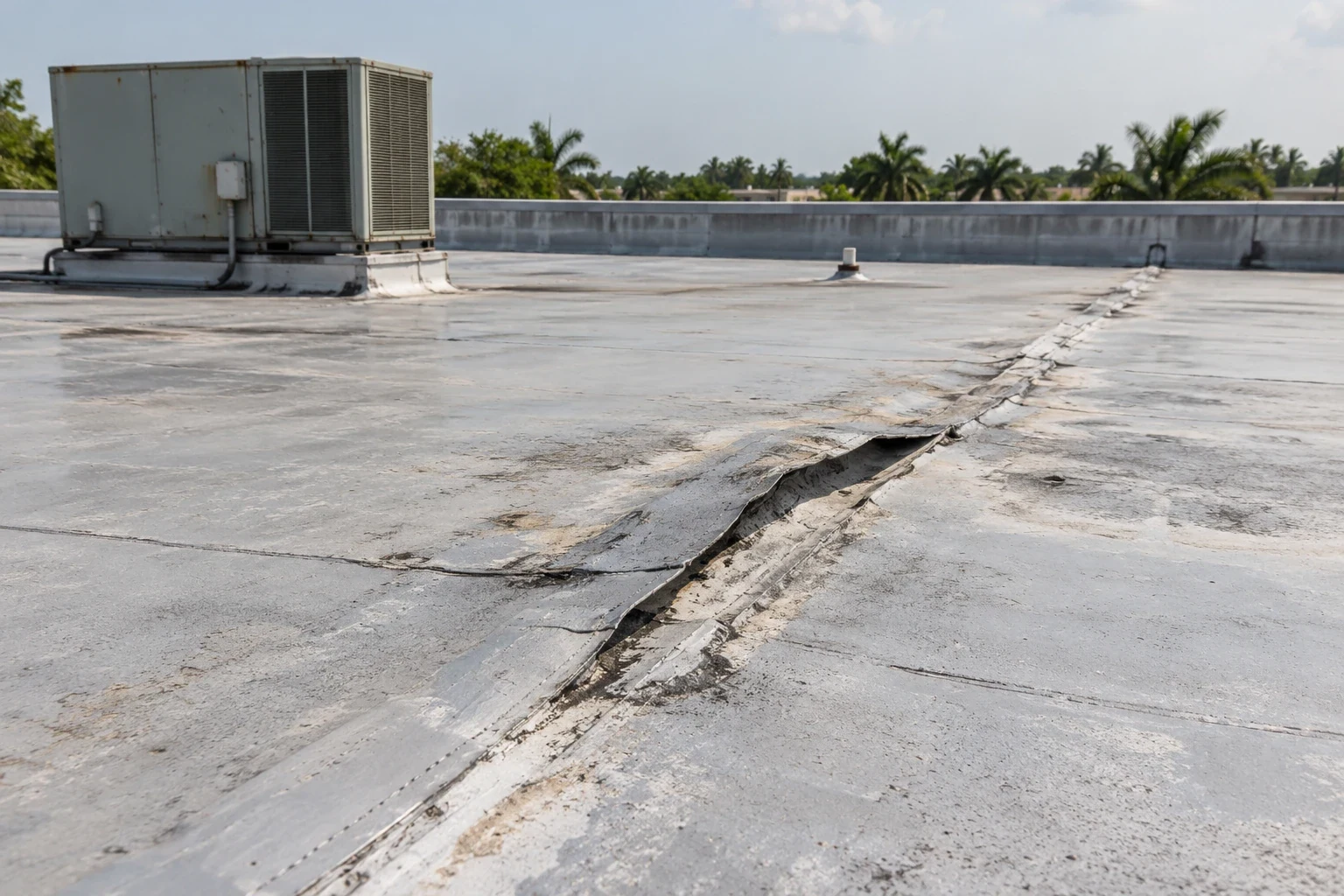
Uplift pressure is highest at corners and along perimeters. A membrane that has lifted there leaves a distinct pattern: a peeled edge, a fold in the sheet, torn seams or a gap at the coping. Edge metal may be bent, pulled from its cleat or missing fasteners.
We walk the full perimeter and mark each disturbance on a plan. Then we check how far in from the edge the damage extends. A disturbance limited to the first few feet suggests an edge-detail repair. A pattern that runs far into the field suggests a loss of attachment, which calls for a broader scope. Edge metal, coping and gutters are inspected as a system, because a loose cap can admit water even when the sheet looks whole.
Wind-borne debris deserves a look as well. Gravel, loose equipment covers and tree limbs can strike the membrane and leave punctures far from the edges, so the walk covers the full field and not only the perimeter.
Rooftop screens, signs and equipment covers catch the wind and transfer load to their supports. We check attachment at each, since a loose screen can damage a sound membrane in the next storm.
Test attachment before judging the surface
A wind event can loosen a roof without leaving a visible tear. Mechanically attached sheets may have fasteners backing out or pulling through. Adhered sheets may have lost bond over patches of the deck. Ballasted systems may have shifted stone toward corners.
We test attachment with pull tests on sampled fasteners, probe adhesion at suspect areas and check ballast depth. The results define the repair boundary. If attachment is sound outside a small area, we repair that area. If it is weak across a section, the correct scope is a section-wide re-fastening or a recover. Surface appearance alone cannot make that call, and an owner should not pay for a repair that leaves the loose area behind.
Mechanically attached systems show fastener rows that no longer sit flat, plates that have pulled through the sheet and seams that ride over their neighbors. Each is photographed and numbered on the plan, with the pull-test result beside it.
Trace water entry from the disturbance
Wind often opens a path that rain then uses. A lifted lap, a displaced counterflashing or a torn boot lets wind-driven rain reach insulation, and water travels along the deck before showing up inside. We trace from the disturbance toward the interior stain, check nearby drains and curbs and use a moisture survey where the insulation may be wet.
If insulation is wet, the repair includes its removal and replacement. Leaving it in place under a new patch holds moisture against the deck and shortens the life of the repair. An infrared moisture survey shows how far the wet area extends, so the removal is no larger than it needs to be.
Moisture follows gravity and slope, not the wind direction, so a roof that was hit from the east may leak at the west drain. The trace covers the whole drainage area and does not stop at the first suspect.
Secure the roof before planning the repair
After a damaging wind, the first job is to prevent further loss. Loose membrane is tied down or cut back, open areas are covered with tarps fastened through battens and loose metal is removed or secured. Debris on the roof is cleared, since it can puncture the sheet in the next gust.
Our emergency roof repair response covers this step at any hour. We photograph the roof as found, before anything is covered, so the condition is on record. In the wet season, a roof left open can take on more water the same afternoon, and the temporary protection is sized to withstand the next storm, not only the visit's weather.
A staged cover also protects interior finishes and stock. Contents under the open area are moved or covered, and the building team is told which area is protected and which still needs attention.
Match the repair to the wind code
Wind design here assumes Exposure C as the baseline, with Exposure D applying only where ASCE 7-22 calls for it, and the city sits in the High Velocity Hurricane Zone. It currently enforces the Florida Building Code, 8th Edition (2023). A wind repair that goes beyond a minor patch may involve permit forms, product approvals and attachment requirements that reflect those exposures.
We confirm the permit scope with the city before pricing and specify fasteners, edge metal and adhesives that suit the required ratings. Where a repair would change the attachment of a large area, we say so and explain what the code asks. The documents are placed in the roof record so the next review, whether by an insurer or a buyer, finds the approvals in one place.
After a regional storm, projects near Interstate 75 and in Miramar compete for the same crews and suppliers, and ordering materials early can shorten how long a temporary cover has to remain.
Record the event for the next decision
The repair closes with a record: photographs before and after, pull-test results, the repair boundary on a plan and the products used. Owners along the Pines Boulevard commercial corridor, in the Chapel Trail area or elsewhere in the city can use the same format. When a storm is more severe, the file supports hurricane damage repair or tornado damage repair in the same sequence.
The owner receives a one-page front sheet naming what was found, what was done at once, what permanent work remains and when a decision stops being optional.
Commercial Roofing Questions
How far from the edge does wind damage usually reach?
It varies with the roof's attachment and the storm. Damage may stop within a few feet of the perimeter or extend across a section. Pull tests and adhesion probes show how far attachment has weakened, and the repair boundary follows those results.
Can a wind-damaged membrane be patched or must it be replaced?
A contained tear or lifted edge supports a patch and an edge-detail repair. Widespread loss of attachment or wet insulation across a section supports a broader repair or replacement. The tests decide, not the appearance.
What should an owner do right after a damaging wind?
Keep people off the roof, photograph interior damage from inside, protect contents and call for temporary protection. Do not climb onto a damaged roof, since weakened areas may not be visible. A crew can secure the roof and document it.
Does the hurricane zone change how wind repairs are done?
It can. Pembroke Pines sits in the High Velocity Hurricane Zone, so larger repairs may involve specific permit forms and product approvals. We confirm the scope with the city and match fasteners, metal and adhesives to the required ratings.
Is a post-storm inspection needed if no leak appears?
Yes, when wind was strong. Damage can sit in a seam or at an edge for weeks before water finds it. A walk with photographs documents the roof and gives a baseline if a claim or a repair is needed later.