Soprema Roofing Systems in Pembroke Pines, FL
Soprema Sopralene, Alsan and Flagon roofs in Pembroke Pines, FL: bitumen lap checks, liquid flashing repairs, wet-season sequencing and HVHZ documentation.
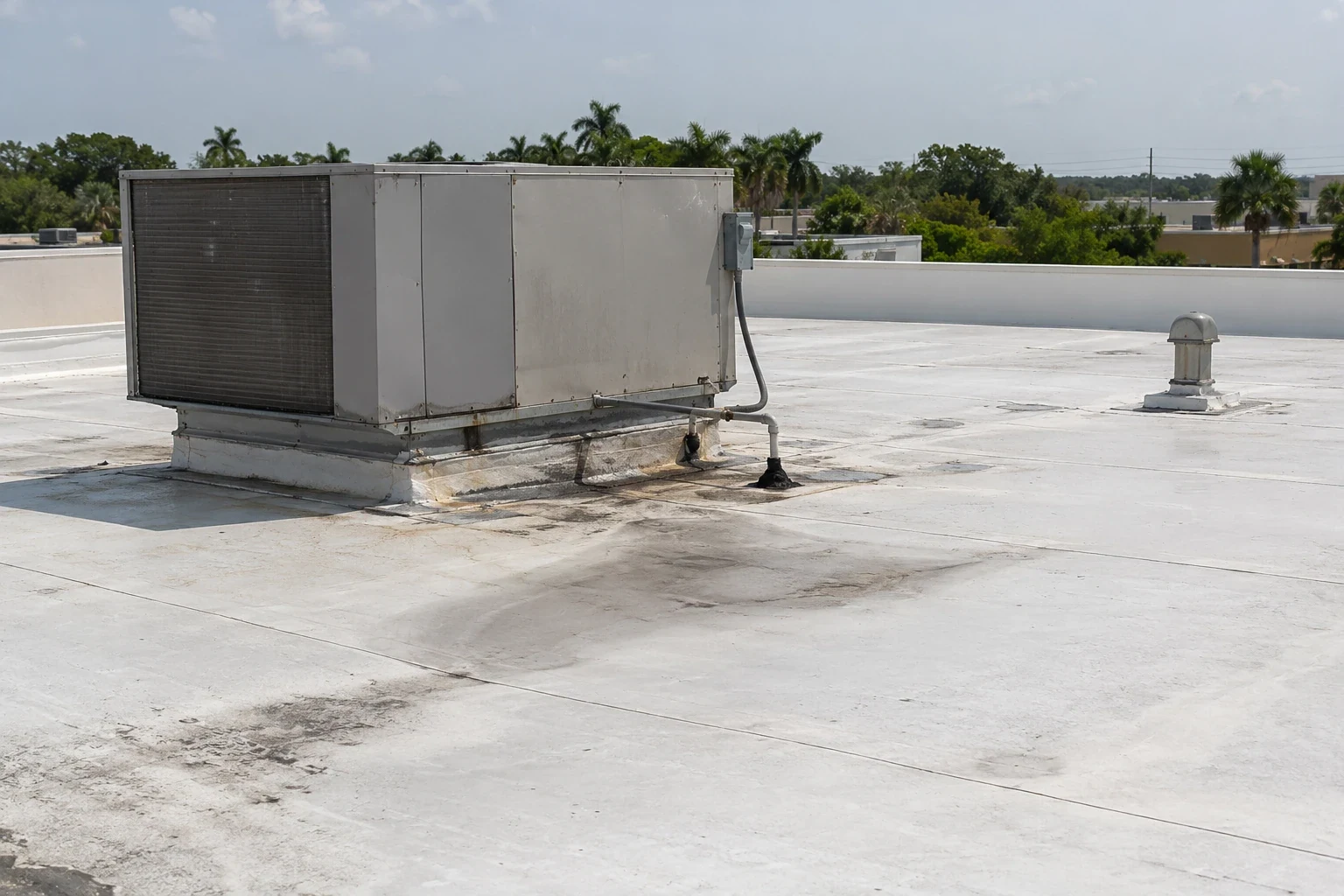
Around a cluster of rooftop pipes, the flashing is where a Soprema roof shows what the last repair crew chose to use. Soprema supplies Sopralene modified bitumen membranes, Flagon PVC and TPO single-ply sheets, and Alsan liquid-applied flashing resins, so one roof can carry several of its products at once. In Pembroke Pines, FL, the inspection finding that shapes the asset decision is which of these materials meets at each transition, whether they bonded to each other and whether the insulation beneath them is dry.
Find where the products meet
Mixed systems fail at their joints. A bitumen cap sheet tied into a liquid-applied flashing, or a single-ply patch lapped over a granulated sheet, needs a compatible bond, and a surface that looks sealed can still be open underneath. We walk the roof, mark each transition and test the edge of the flashing for lift. Liquid-applied flashings are checked for pinholes, thin spots at corners and cracking at movement joints.
On bitumen sections, we look at the laps, the granule surface and any blisters. We press along the lap line, look for the bead of asphalt that should show at the edge and photograph each finding against the roof plan. On single-ply sections, we probe the welds.
Separate retainable flashing from failed flashing
Flashing repairs are retention decisions. If the existing liquid-applied or sheet flashing is firmly bonded, clean and flexible, it can often be reinforced and re-coated. If it has debonded, cracked or trapped moisture, it must be removed to sound substrate. The boundary of that removal goes on the roof plan, together with the boundary around any affected insulation found by infrared and selective openings.
The retained field membrane is judged separately. A bitumen sheet with intact reinforcement and a few open laps is a repair candidate. A sheet with fractured reinforcement or widespread granule loss may call for a larger package. The report states the evidence for each judgment so the asset manager can see what drove the scope.
Repair in the order the materials cure
Sequence matters when several materials meet. We clean and prime the substrate, repair the deck or insulation within the boundary, set new plies or membrane with laps that shed water, then form the flashing. Liquid-applied resin is placed with reinforcing fabric, applied in the thickness the product requires and protected from rain during its cure window. Bitumen laps are heat-welded or adhered as the system requires, with a bleed-out at each lap as the check.
Each cure has weather limits, and the plan states them. Temperature, humidity and surface moisture all affect adhesion, so the crew sizes the day's work to the forecast. Every stage is photographed in position, which gives the next inspector a record of how the transition was built.
Compare layered and single-ply paths
The options differ in weight, speed and flashing detail. Modified bitumen offers a multi-ply surface that stands up to foot traffic and rooftop service. PVC offers a welded, chemically resistant sheet. Liquid-applied flashing suits roofs with dense penetrations, where cutting and welding sheet around every pipe is slow and leaves many seams. A recover is possible only over a dry, regular roof, and replacement clears the deck and resets the system. We state the consequences for roof height, curbs and equipment in the quote.
Timing is part of the comparison. Liquid-applied flashing cures in place and avoids the many cuts and welds that sheet flashing needs around a dense curb cluster, which shortens the time a penetration stays open. Bitumen systems take longer to lay but give a thicker, multi-ply surface. The asset manager sees both durations beside the cost drivers and chooses the one that fits the operating schedule of the building.
Plan for the hurricane zone and the wet season
Soprema systems installed in the city fall under High Velocity Hurricane Zone rules and the 2023 Florida Building Code edition. Because the permit file calls for a zone reroof statement, an insulation certification and a rooftop equipment form, approvals and paperwork are written into the scope from the start. Between mid-May and mid-October the region collects 60 to 70 percent of its average yearly rainfall, mostly in near-daily showers. Liquid-applied products and bitumen laps both need dry surfaces, so the opening plan is sized to the forecast. The roughest weeks come first, from mid-May into early July, with wind, tornadoes, lightning, hail and flooding on record, so covers are in place before work begins and the crew stops opening new sections by early afternoon.
Trace moisture through the insulation
Flashing failures send water into the insulation, and the insulation then carries it away from the leak point. A stain on a ceiling tile can sit many feet from the opening, so we map moisture across the whole roof zone before deciding what to remove. An infrared scan at the right time of day shows temperature differences where wet boards hold heat, and a moisture meter confirms the readings at test points. Selective openings, sealed the same day, show what the instruments suggest.
The result is a boundary on the roof plan. Boards inside it come out; boards outside it stay if they test dry and sit firmly under the membrane. New boards are cut to the original thickness, which keeps the surface flat and preserves the slope toward the drains. The report records the readings at each test point, so a later survey can show whether the wet area has grown, shrunk or stayed the same.
Where a roof has been recovered before, the survey must look through more than one layer. At each opening the layers are counted, and any spot where an older layer may be holding moisture under a newer surface is flagged.
Stage the work in Davie and Hollywood
Nearby cities add industrial and commercial parks to the mix. Davie reports more than 900 acres of industrial-zoned land, with distribution, manufacturing, healthcare, aerospace and technology among its industries. Hollywood identifies two commerce and industrial parks. Those descriptions guide access planning, such as dock use and truck movement, but they do not describe any roof, so each building is inspected before the phase plan is written. Lift placement depends on dock courts, truck turning room and shared parking, and goods stored under the work area are covered or moved with the tenant before any bay is opened.
The closeout file lists the products identified, the transitions, the repairs made and the next work package, and it says plainly which areas were not examined. A Johns Manville or GAF roof is handled the same way.
Commercial Roofing Questions
What is liquid-applied flashing and when is it used?
It is a resin applied in place, usually with reinforcing fabric, to form a continuous flashing around pipes, curbs and irregular shapes. It suits roofs with many penetrations, provided the substrate is clean, dry and compatible.
Can a liquid flashing be applied over an old repair?
Only if the old repair is bonded, clean and compatible. We test adhesion on a small area, and remove failed material to sound substrate when the test fails.
How do you check a bitumen lap?
We look for the bead of asphalt at the edge, press the lap for movement and probe for voids. Open or lifted laps are marked and photographed against the roof plan.
Can different Soprema products be combined on one roof?
Yes, when the transitions are detailed for compatibility. We identify each product, test the bond and record where each is used.
What interrupts liquid-applied work?
Rain, high humidity, surface moisture and temperature outside the product's limits. We size the day's area to the forecast and protect the resin during its cure window.