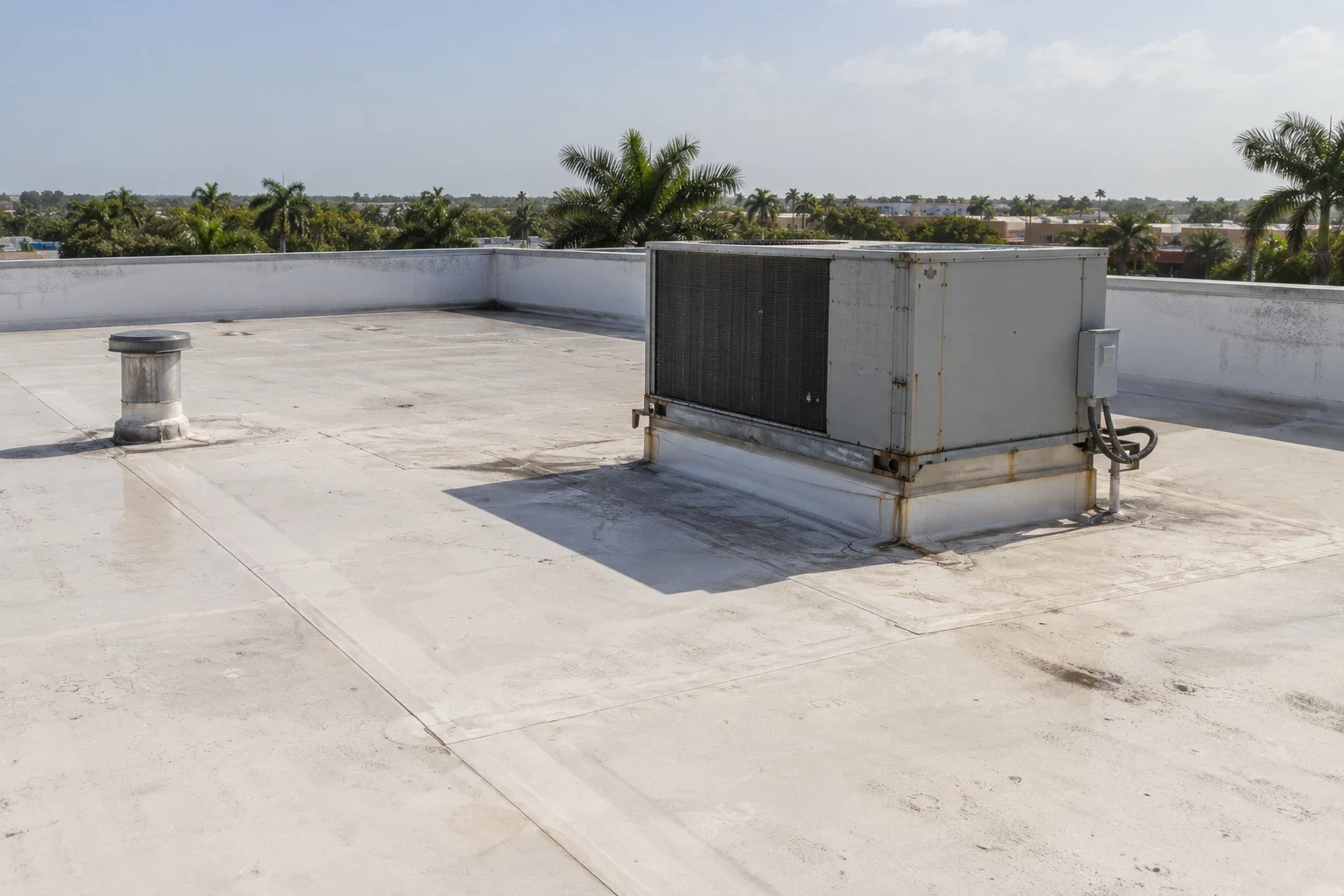
Versico Roofing Systems in Pembroke Pines, FL
Versico single-ply roofs in Pembroke Pines, FL: fastener and plate checks, seam findings, wind attachment review, HVHZ documentation and phased reroofing.
A row of fasteners that has begun to lift the membrane into small bumps tells an asset manager more about a mechanically attached roof than any leak report does. Versico supplies single-ply membranes, including TPO, EPDM and PVC, along with insulation and accessories, and its roofs can be mechanically attached, adhered or ballasted. The inspection finding that sets the budget decision is therefore the attachment method, the condition of the fasteners and plates, and the dryness of the insulation they hold. In Pembroke Pines, FL, that finding carries extra weight because of the hurricane zone rules.
Read the attachment before reading the seams
On a mechanically attached roof, membrane is secured at the seams with fasteners and plates, so a backed-out fastener becomes a bump and a bump becomes a wear point. We walk the roof, mark the lifted fasteners, and measure how many sit in a single row, because a cluster of failures means a deck or insulation problem, not a set of unlucky screws. Where the system is adhered, we look for areas where the bond has released and the sheet moves under foot.
Seams come next. Welded or bonded laps are probed, and the finding is photographed against the roof plan. Billowing between fasteners in a gust is a separate sign, because a sheet that flutters works on the seam plates and the deck beneath them. Flashings, pipe boots and terminations are checked last, since they often fail first.
Decide how much attachment can be retained
The retention question is whether the existing attachment can carry the roof or must be restored. Fasteners that have corroded or pulled out of a thin deck cannot be reset in the same hole, so we test pull-out resistance where the deck allows and note the result. If the deck is sound, replacement fasteners and plates can restore the row. If the deck is weak or corroded, a larger scope is needed, with deck repair and new attachment.
Moisture adds a second boundary. Infrared scans and selective openings locate affected insulation, and the boundary is drawn on the roof plan. A roof with isolated wet areas and sound attachment suits a local repair. A roof with wet insulation in several zones and loosening fasteners across a field points toward replacement, and our report shows the evidence for that conclusion. The owner receives the decision as two scopes: what the local repair would cover and what the larger package would add.
Compare restoring, recovering and replacing
Restoring the attachment and repairing seams is the least disruptive path and suits a sound deck with dry insulation. A recover over a mechanically attached roof can be practical when the old roof is dry, but it adds weight, raises the roof height and changes the attachment design, so the load path must be confirmed. Replacement clears the deck, allows corroded fasteners to be removed and lets insulation be re-engineered. Each option affects flashing height and rooftop equipment, and the quote lists those effects. For membrane chemistry, the choice among TPO, EPDM and PVC follows the exposure, not the brand.
Check wind design and the paperwork that follows
Versico assemblies here are designed within the High Velocity Hurricane Zone, using Exposure C as the baseline unless ASCE 7-22 puts a building into Exposure D. The 2023 code edition applies, and the permit package normally lists a zone reroof statement, an insulation certification and a rooftop equipment form. Perimeter and corner attachment are the places where wind design is tested first, so we review fastener spacing, edge metal and termination details against the design professional's assumptions.
Tropical systems matter most from August to October. A roof opened late in the season is sized to what can be dried in before a system approaches, and temporary protection is planned before the first cut.
Repair the attachment in rows
Attachment repairs run row by row. We locate the seam fasteners by probing for plates, remove the lifted ones, test the deck beneath, and install replacement fasteners at the spacing the design calls for. Plates are set flat and sealed under a membrane patch, and the patch is welded or bonded with a lap that sheds water. Where a row has failed along its whole length, we open the seam, inspect the deck and insulation, and re-attach with new hardware before closing the membrane again.
Flashings follow. Cracked pipe boots are replaced, curbs are rebuilt to the height code requires, and terminations are fastened again with a sealant compatible with the substrate. Drains need the membrane to enter the bowl without folding, and the strainer must stay accessible. Every step is photographed in position, so the owner can see what was removed, what was retained and where the new hardware sits.
Walk pads go in last, at service routes to rooftop equipment, so maintenance traffic wears a protected path and not the field sheet. We also leave a short written note of the fastener spacing used, so the next technician can match it.
Plan access at office parks and in neighboring towns
We work across the Broward County suburbs around Pembroke Pines. Miramar contains employment centers, corporate parks, restaurants and retail centers, and Weston has access to I-75, I-595 and US 27 and is described as a master-planned community with corporate and healthcare activity. Those descriptions say what is nearby and not what is on each roof, so we identify the system building by building. In each location, access routes, staging and tenant hours go on the phase plan before a crew mobilizes.
Roofs near the Everglades edge in Weston and the corporate parks of Miramar share the same wet-season rule: open only what can be closed. The forecast is checked repeatedly through the morning, new bays stop opening by early afternoon, and the day ends with a walk along every seam, edge and penetration. Corporate and healthcare tenants need notice before noisy work, so the schedule is shared with the building contact a few days ahead, along with the location of the lift, the debris container and the roof access ladder.
Put the recommendation in writing
The file at closeout names the system found, the fastener and seam observations, the repairs made and the next work package, with a note on anything left unexamined. It feeds the capital plan and the warranty file. A Carlisle SynTec or GAF roof receives the same attachment review before work is priced.
Commercial Roofing Questions
Why do fasteners back out of a mechanically attached roof?
Deck vibration, thermal movement and corrosion all loosen them. A row of lifted fasteners usually points to a deck or insulation problem, which we check before replacing hardware.
Can a few lifted fasteners be reset in the same holes?
Often not. A hole that has lost its grip needs a longer or larger fastener or a new location. Where the deck permits, fasteners are tested for pull-out resistance and the readings are logged.
Does a recover change the wind design?
It can. Added layers change weight and attachment, so the load path and the approvals must be confirmed before work. The design professional signs off on the assumptions.
How much roof can be opened in one day?
Only what can be dried in before storms build. In the wet season we size each bay to the forecast and the crew's pace, and stage temporary protection at the edge.
What records come with the work?
Photographs by roof zone, fastener and seam findings, repairs made, excluded areas and the next work package, so the asset manager has a basis for the next budget decision.