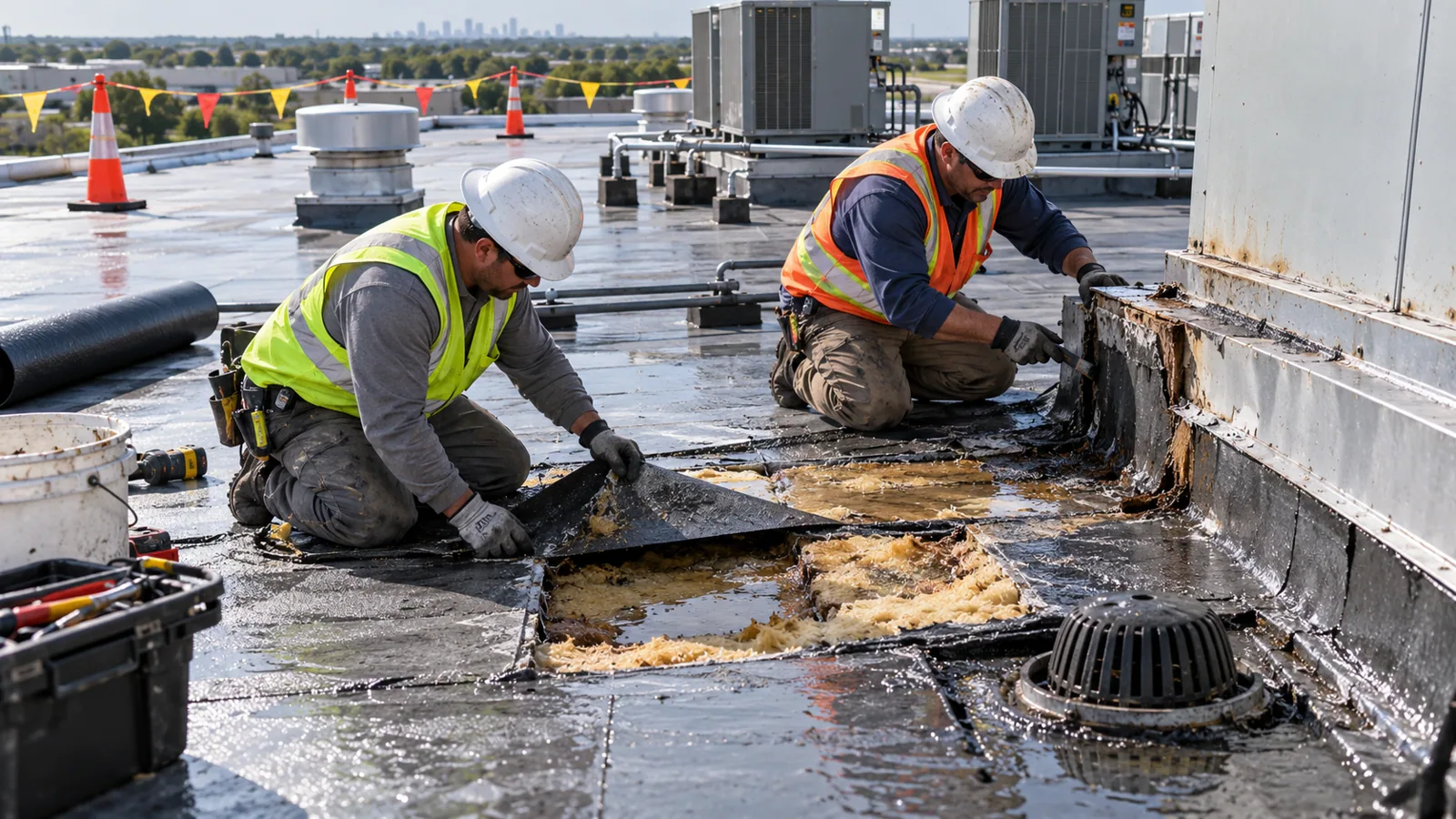
Infrared Roof Moisture Survey in Pembroke Pines, FL
Investigate concealed roof moisture in Pembroke Pines with suitable thermal conditions, selective confirmation and removal boundaries tied to findings.
A broad thermal anomaly beside a repaired seam can change the amount of insulation considered for removal, but only after its cause is examined. Heat patterns can identify suspect areas without proving that each area contains moisture. In Pembroke Pines, FL, we use infrared roof moisture surveys to guide that investigation and help an asset manager distinguish retainable material from affected insulation. The survey should support a construction decision rather than substitute an image for a confirmed finding.
Moisture within a suitable roof assembly can change how heat is stored and released. An infrared survey looks for relevant temperature differences under conditions that allow those differences to be interpreted. We connect the observations with roof construction, leak history and selective confirmation. The findings can inform replacement removal boundaries, recover eligibility or a targeted investigation of concealed deterioration.
The assembly determines suitability
Not every roof construction produces a useful thermal response. Membrane type, insulation, ballast, surface coverings and reflective materials can affect what is observed. We examine the assembly and the condition question before recommending a survey. Where the roof construction or available conditions make interpretation unreliable, another moisture-assessment method may be more appropriate. The owner's decision needs usable evidence, not a preferred instrument applied regardless of the roof.
Known repairs and differences in insulation thickness also matter. A repaired area can retain and release heat differently from surrounding construction even if the assembly is dry. We compare thermal patterns with the roof layout and available construction information. That comparison helps identify which anomalies deserve confirmation and which may be explained by a change in material or geometry. It also prevents a repair boundary from following every temperature variation automatically.
Timing affects the observation
Thermal contrast depends on conditions before and during the survey. Solar heating, cooling, wind, rain and surface moisture can affect the pattern being examined. We evaluate whether the observation window can produce meaningful information and whether roof access is safe. A survey conducted under unsuitable conditions may leave an important retention question unresolved, regardless of the apparent clarity of the image.
South Florida has frequent showers and thunderstorms through its wet season. Those events can restrict access and interfere with a suitable thermal observation window. Pembroke Pines station July daily maximum-temperature normals are 91 to 92 degrees Fahrenheit, but hot air alone does not establish that a roof survey will be useful. We select the method and timing from the assembly and actual conditions, rather than treating the regional heat as sufficient evidence that moisture can be detected.
Anomalies need confirmation
A suspect thermal pattern is a reason to investigate. We compare it with visual findings, drainage, equipment and prior leak locations, then use appropriate selective confirmation to determine what the assembly contains. An opening can establish moisture, identify the affected layers and show whether the material remains suitable to support new work. The owner should know which mapped areas have been confirmed and which remain indications requiring further examination.
Confirmation locations need a purpose and a plan for closing the roof. We discuss authorization, occupied space and weather protection before making an opening. Additional locations may be needed where the anomaly changes across a roof area or where several construction types meet. The scope should be sufficient to resolve the retention question without presenting an untested boundary as a precise map of all concealed deterioration.
The local use controls access
Warehouse and flex properties in Chapel Trail can contain stored goods or activities that make an interior consequence particularly disruptive. We coordinate investigation locations and protection with the manager before opening a suspect area. Access to the underside of the roof, loading schedules and equipment service routes may affect how confirmation can proceed. Those operating constraints belong in the survey plan because the selected method must remain workable on the building.
Along SW 145th Avenue, the office corridor runs parallel to Interstate 75 south of Pines Boulevard. A survey for an office property there may need coordination with sensitive rooms, tenant access and maintenance personnel. Work in the Chapel Trail commercial area and in office settings can share a moisture question while requiring different access arrangements. We identify those differences before selecting the investigation sequence.
The findings guide retention
A roof recover requires an acceptable retained base. Confirmed affected insulation can require removal even where the membrane above it appears continuous. The survey helps direct that assessment, while selective examination establishes the material and depth needing attention. We separate localized correction from a finding of distributed moisture because those conditions can lead to different capital recommendations.
For a proposed roof recover, the investigation should establish whether the extent of removal preserves a reasonable retention option. For a recurring leak repair, it can help explain why water entry has produced a wider concealed consequence. Moisture mapping does not by itself locate every entry point. The repair still needs to address the connection admitting water, rather than remove insulation while leaving the defect active.
The record separates certainty from indication
We identify the surveyed area, observation conditions, thermal findings and confirmation results in a usable record. The report should connect those items with recommendations for further examination, repair or removal. Where the survey cannot resolve a roof area, that limitation needs a corresponding next action. An asset manager should not have to infer which markings represent confirmed affected material and which represent a pattern awaiting assessment.
An office roof assessment may use those findings to divide immediate corrective work from later capital work. We can incorporate the survey within written roof condition findings alongside leak observations and assembly information. Subsequent decisions then have a defined basis for comparing retained areas, completed removals and any remaining uncertainty. The thermal image becomes one part of that record, with its interpretation tied to the actual roof.
Commercial Roofing Questions
Does a colored thermal area mean the insulation is wet?
A temperature difference identifies an anomaly whose cause needs evaluation. Material changes, surface conditions and other influences can create differences unrelated to moisture. We compare the pattern with the assembly and confirm suspect locations using suitable methods. The recommendation distinguishes confirmed affected insulation from an indication that still requires investigation, so removal is not approved simply because an area appears different in an image.
Can the survey prove that the rest of the roof is dry?
A survey can improve the assessment under suitable conditions, but coverage and interpretation have limits. Construction differences or unsuitable conditions may obscure moisture. We describe the examined area and the confirmation basis rather than treating an unmarked area as a definitive finding of dry material. Where retention is a critical decision, further investigation may be appropriate even if the thermal pattern appears uniform.
Will you remove every panel inside the mapped boundary?
The removal scope follows confirmed condition and a workable construction boundary. Thermal mapping helps direct examination but does not automatically define each panel to remove. Selective openings and observations during the work can refine the extent. We explain the initial assumptions and the circumstances that could expand or reduce the removal package as the concealed assembly becomes accessible.
Should we schedule the survey during active rain?
Rain, wet surfaces and unsafe access can prevent a useful survey and affect thermal interpretation. We evaluate the forecast and the conditions needed for the particular assembly before scheduling. An active leak may require protection first, followed by moisture investigation at a more suitable time. The urgency of the leak and the timing needed for reliable thermal observation are separate decisions.
How does this help with the capital budget?
Confirmed moisture extent helps compare localized removal, a recover and broader replacement work. It also identifies investigation gaps that need resolution before a construction scope is finalized. We connect those findings with assembly requirements and detail corrections. The budget becomes more useful when it separates known affected material from contingencies that await exposure, rather than assigning certainty to an unconfirmed thermal map.