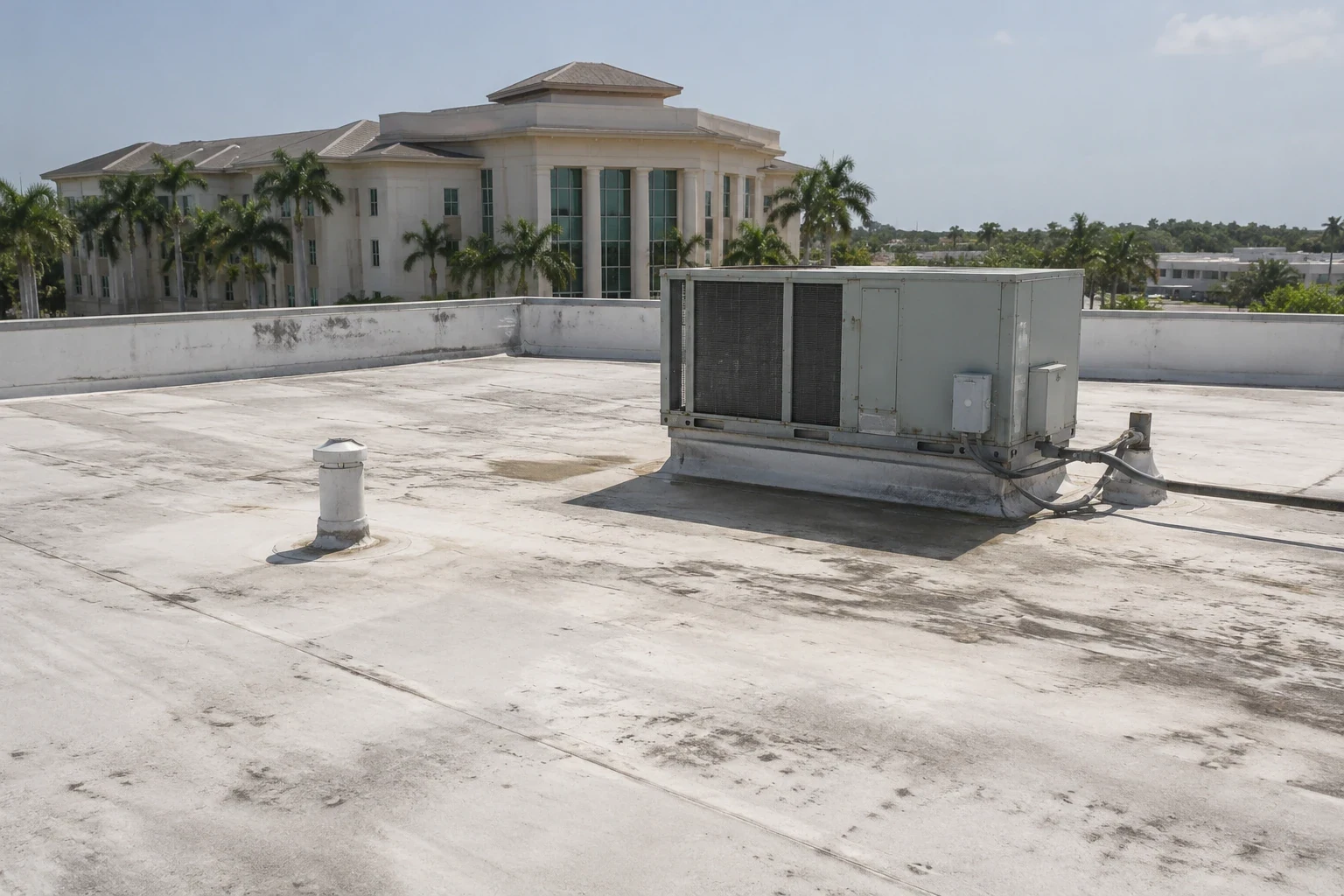
Commercial Roofing in Hollywood, FL
Roof inspection, repair and replacement planning for Hollywood, FL commercial and industrial buildings, with phased openings built for South Florida storms.
Cracked sealant at a parapet corner is a small finding until the building next door starts a construction phase and the roof becomes a shared boundary. Hollywood sits in Broward County between Miami and Fort Lauderdale, and the city reports roughly $1.5 billion in active real-estate development, including its downtown. New work beside older buildings changes the roof question: dust, crane swing, tie-in walls and shared drainage all enter the scope. Hollywood also lists two commerce and industrial parks, so older flat roofs and newer ones stand within a short drive. We start with the inspection finding, then decide what the owner can retain and what has to be corrected first.
New construction changes old roofs
A neighboring project puts the existing roof at risk in ways the owner did not budget for. Debris falls on a membrane, fastened scaffolds bear on a parapet, and walls rise against a flashing that was never meant to meet them. We record the roof condition before the adjacent work begins, with photographs of seams, drains and walls, so later damage can be told apart from earlier wear.
If a new wall rises against an old one, the tie-in needs a proper termination, a reinforced corner and a drain that still works. We check those details early. A roof that is dry today can be wet in a month if a downspout is rerouted without anyone noting the change, which is why the baseline photographs include every outlet. We repeat the same photographs when the neighbor's work is done, so the two sets can be compared side by side.
Mixed-use roofs carry more than membrane
Redevelopment tends to place residential, retail and office uses within a single structure, and the roof then carries equipment for each. Amenity decks, planters, pipes, antennas and exhaust terminations all touch the membrane. A leak on such a roof can have a dozen possible sources, and an interior stain in a residential unit may trace to equipment serving a restaurant below the next floor.
We map every penetration and every item set on the roof, then test the suspect details one by one. An apartment roof that shares a structure with ground-floor retail needs the same discipline as a stand-alone commercial building, and the scope should say which party owns each detail.
Shared roofs also raise a retention question. Insulation under an amenity deck or a planter bed is hard to inspect and expensive to replace, so we test it before the deck is built or rebuilt. If the board there is wet, the removal boundary reaches beneath the amenity, and the owner should hear that before the design is final and not after the planters are set.
Commerce parks need phased scopes
The city's economic-development site identifies two commerce and industrial parks. Industrial and flex tenants share driveways, docks and parking, so a roof project in one building can interrupt a neighbor's deliveries. We prepare a staging drawing that shows the hoist, the waste route and the dock doors that must stay clear.
For a flex-industrial roof or a warehouse roof, the work is divided into sections. Each section opens only after temporary protection is staged above stored goods, and closes before the afternoon storm window. The owner receives a phase list that shows which section goes first and why, so the next work package follows from the findings.
Docks deserve their own check. Water pools near a dock leveler pit or a canopy drain, and a failed flashing at a loading wall can drip onto stock staged below. We look at those transitions in every industrial building, because the repair there is small and the loss it prevents is not.
Heat and rain wear the same seams
The 1991-2020 normals for the Pembroke Pines station put July afternoons at 91 to 92 degrees, and high summer heat indexes in the region can top 100. Membranes expand and contract through those days, then take a wet-season shower in the evening. The cycle works on seams, flashings and sealant long before a leak shows.
We probe seams, press on edge terminations and look for shrinkage at inside corners. A seam failure repair is a modest job when the seams are isolated, and a larger one when the pattern runs across several sections. The same cycle of heat and afternoon rain acts on Hollywood roofs, though how far it has progressed on any one of them is a question for the probe. We record what the probe finds on the building itself.
Storm calendars limit the opening
Showers and thunderstorms arrive nearly every day once the wet season sets in. The roof we open today must be closed tonight. We watch the radar, stage temporary protection beside the work and keep the open area small enough that the crew can seal it in a short time.
Tropical systems are a concern in late summer and early fall, so a replacement phase scheduled for those months includes a plan to secure loose material and edges. After a storm, hurricane damage repair begins with a record of the roof and temporary protection, followed by a scoped repair sequence. We bill emergency leak work apart from planned capital work, so the owner sees what the emergency cost and what still needs a plan.
Rank the roofs before the next phase
An owner with several Hollywood buildings can use a ranking that applies the same measures to each: moisture extent, seam condition, remaining service life and the operating risk of a failure. We produce that ranking from inspections and give a recommended order of work.
The ranking feeds a roof capital plan and a roof condition report for each building. Owners in Hallandale Beach, Dania Beach or Pembroke Park can add those roofs to the same list. The first phase goes to the building where a failure would be most expensive, and later phases follow as money allows. If an owner plans to sell or refinance, the same record answers a lender's questions about roof life without a second round of inspections.
Commercial Roofing Questions
What documentation protects an owner when a neighboring project begins?
A dated condition record with photographs of seams, drains, walls and parapets. It lets the owner separate prior wear from damage that occurs during adjacent work. We prepare that record before construction starts and update it if the neighbor's work reaches the shared boundary.
Why might an interior leak not match the nearest rooftop penetration?
Water moves along insulation, decking and ductwork before it appears inside. On a mixed-use roof, several items can sit close together. We test each suspect detail and use moisture mapping to follow the path, so the repair addresses the true source.
How large a roof section can be opened in one day?
Only as much as the crew can dry in before storms build. The limit depends on the crew size, the system being installed and the forecast. We set it each morning and keep temporary protection staged beside the opening.
When should a flex-industrial roof be coated and when should it be replaced?
Coat it when the insulation is dry, the membrane is bonded and the seams are sound. Replace it when moisture is widespread or repeated repairs have failed. A survey and a few cores establish which case applies, and we put the results in writing.
Can roof work proceed in a building with ground-floor retail?
Yes, with attention to entrances and loading. We route hoisting and debris away from customer doors, protect interiors beneath the open section and schedule noisy tasks away from peak hours. The building manager approves the plan before the first day.