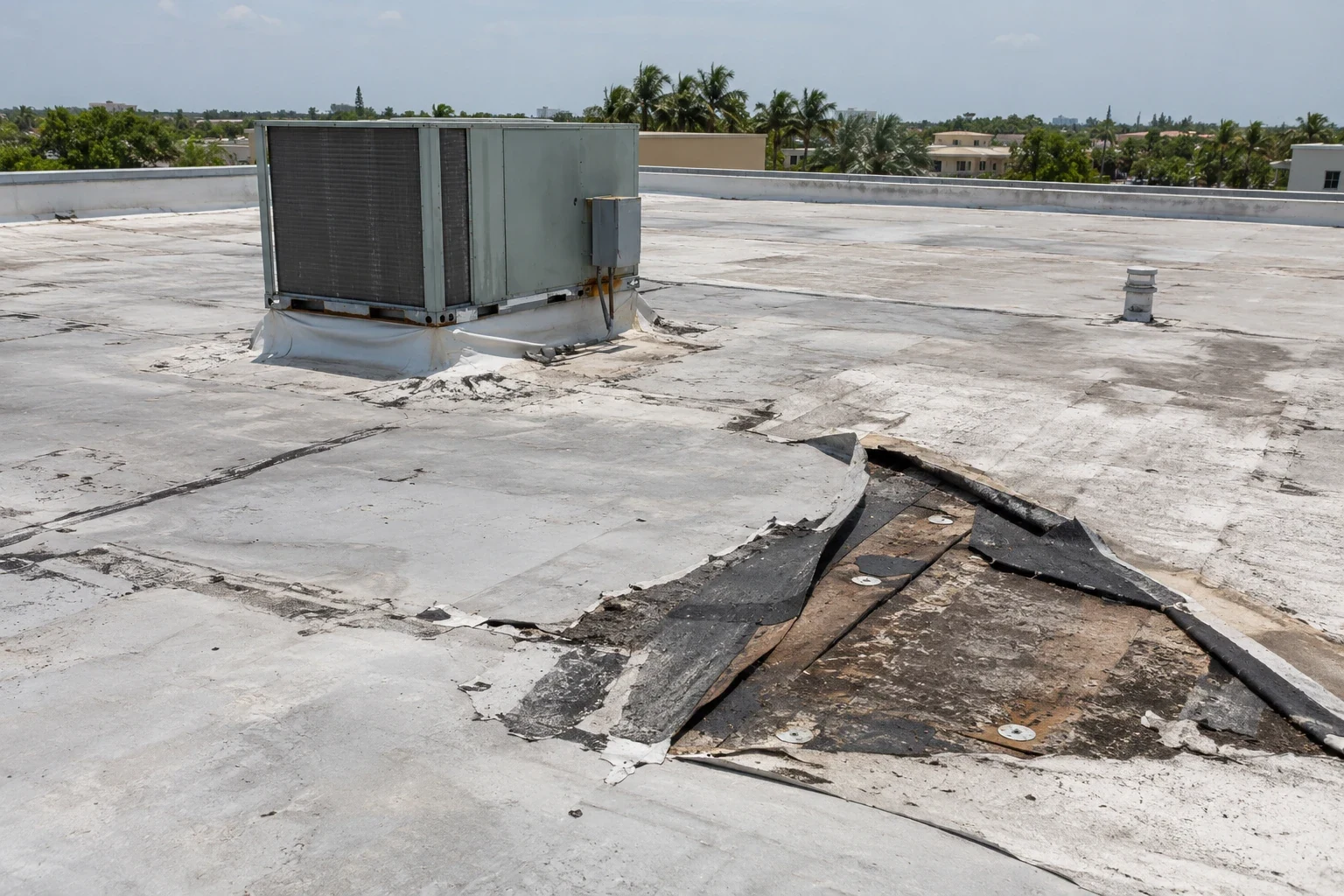
Commercial Roof Recover in Pembroke Pines, FL
Assess a roof recover in Pembroke Pines with existing-layer checks, moisture investigation, added-load review and workable flashing transitions.
An intact membrane above dry insulation can justify examining a recover, but a second roof adds more than a new weather surface. It changes roof weight, finished height and the relationship between the roof field and its flashings. For an asset manager in Pembroke Pines, FL, the first decision is whether the existing assembly provides an acceptable base. We investigate that question before treating an overlay as the preferred capital option.
A recover leaves approved portions of the existing roof beneath a new assembly. That approach may reduce removal and its effect on occupied space, but it also retains the consequences of concealed defects unless they are corrected. We compare recover eligibility with complete roof replacement using the same condition findings. The recommendation must account for moisture, attachment, existing layers and the details that the added roof will change.
The existing layers need a count
A coating, an older membrane and a second roof can be difficult to distinguish from surface observation alone. Selective openings establish the actual layers and substrate. Existing records help direct that examination, but a drawing does not replace an opening where the installed assembly is uncertain. The number and condition of existing roof layers affect whether a recover is permitted and whether retention is technically reasonable.
We also consider the applicable building requirements and the condition of the supporting deck. Pembroke Pines currently enforces the Florida Building Code, 8th Edition (2023), and lies within the High Velocity Hurricane Zone. Recover eligibility and the proposed attachment must be evaluated for that project. Structural assessment of added load belongs with the appropriate design professional; a roofing inspection can identify the need for that assessment without claiming to establish structural capacity.
Dry material is a prerequisite
Retained wet insulation can continue to compromise the assembly beneath a new membrane. We examine leak history, investigate suspect areas and determine whether moisture is isolated or distributed. A suitable infrared moisture investigation may help map anomalies, with selective confirmation needed to establish moisture and removal depth. The resulting scope should distinguish confirmed affected material from areas requiring further examination.
Localized removal can sometimes prepare a suitable roof for a recover. The repaired area must leave a firm, compatible substrate rather than a hollow or uneven patch beneath the new assembly. Widespread deterioration can erase the practical benefit of retention. We make that consequence visible in the decision: extensive removal, difficult transitions and substantial substrate correction may support replacement even where an overlay initially appears simpler.
Height changes the details
Additional insulation and cover board raise the roof field. A curb that had sufficient flashing height can become inadequate, a drain can require adjustment and a wall termination can need reconstruction. We examine these connections before pricing the new surface as though it could be laid across the existing roof without other work. Drainage paths also need to remain functional after the added thickness changes elevations.
Equipment supports require particular attention. Existing conduits, piping and service clearances can restrict the roof buildup or complicate removal at curbs. We identify which equipment transitions need coordination and which can remain with new flashing. Correcting penetration flashing connections may be part of a recover scope even where the equipment itself is retained. A sound field membrane does not compensate for a shortened or poorly supported flashing detail.
Retention has an operating benefit
Pines Boulevard contains a concentration of commercial development. Where an occupied retail or office building has a recoverable assembly, reducing demolition may simplify interior protection and debris movement. That benefit depends on the roof findings, not the property's commercial use. We still plan material lifts, temporary access restrictions and any work at air intakes or equipment serving occupied rooms.
The office corridor along SW 145th Avenue runs parallel to Interstate 75 south of Pines Boulevard. For an office property there, the recover decision may involve coordinating concentrated work at curbs while retaining a suitable field assembly. We set that sequence alongside the tenant schedule and maintenance access. Work in the SW 145th Avenue office corridor needs a practical way to complete those details without treating continued occupancy as permission to leave vulnerable connections unfinished.
Attachment needs a sound path
Fastening through an existing assembly requires a suitable connection to the deck and an approved configuration. Adhesive attachment requires an appropriate substrate and preparation. We evaluate the proposed load path, insulation and cover-board arrangement, perimeter treatment and compatibility of retained materials. The existing roof's apparent stability does not establish that a new system can use its attachment without further evaluation.
A recover using PVC roofing or another compatible assembly must address the separation and substrate conditions that the system requires. Surface contamination, unevenness and incompatible materials can affect installation. South Florida wet-season thunderstorms also influence preparation and opening limits at localized removals. We organize the work sequence so investigation repairs and detailing create a suitable base before the new membrane closes those areas.
The alternative needs a clear limit
Recover pricing should include substrate preparation, moisture removal, curb changes, drainage adjustments and disposal of localized material. Those items determine whether retention provides a practical advantage. A comparison that prices only the new membrane can miss the capital work necessary to make it perform. We describe the circumstances that would move the recommendation toward replacement and identify any unresolved conditions that need an opening before approval.
The retained roof should remain identifiable in the asset record. Future leak investigation and eventual replacement benefit from knowing which layers remain and where repairs occurred. We include that distinction in written roof condition findings and the completed-work record. Retention is a deliberate construction decision with future consequences, not an assumption that the concealed assembly no longer matters once another membrane is installed.
Commercial Roofing Questions
Does a recover mean none of the existing roof comes off?
Affected insulation, unsuitable substrate and deficient details can require removal even within a recover project. We identify those areas separately from the retained field. The new roof needs a suitable base throughout its extent. Where corrective removals become widespread, the capital comparison should be revisited because the assumed benefit of leaving the existing assembly may no longer apply.
Can another membrane be installed over a prior recover?
Existing layer count is a threshold question, not a detail to resolve after material selection. We establish the roof construction and evaluate the applicable limits before recommending another layer. Prior work may also conceal moisture or leave uncertain attachment. An additional recover is not accepted merely because there is room beneath the flashing termination or because the existing surface looks continuous.
Will an overlay improve drainage by itself?
The added membrane normally follows the geometry beneath it. Drainage improvement requires a deliberate design for elevations, slopes and discharge points. Tapered insulation may help where appropriate, but curb heights and perimeter details must accommodate the buildup. We examine persistent water areas and the drain connections before presenting drainage correction as part of a recover recommendation.
What would make you recommend removal instead?
Distributed wet insulation, an unsuitable deck, unacceptable existing layers or detail changes that require extensive demolition can favor replacement. The recommendation also considers whether the retained material can support the proposed assembly. We show the owner the finding that drives that choice, so a larger capital commitment follows an identified limitation rather than a preference for one installation method.
What records should remain after a recover?
Keep the identified existing layers, moisture-removal areas, new assembly information and photographs of reconstructed connections. Those records help maintenance personnel investigate later damage without mistaking the entire buildup for new material. We also identify any remaining roof zones outside the work boundary. A recover is easier to manage when the retained and newly installed components are clearly distinguished.