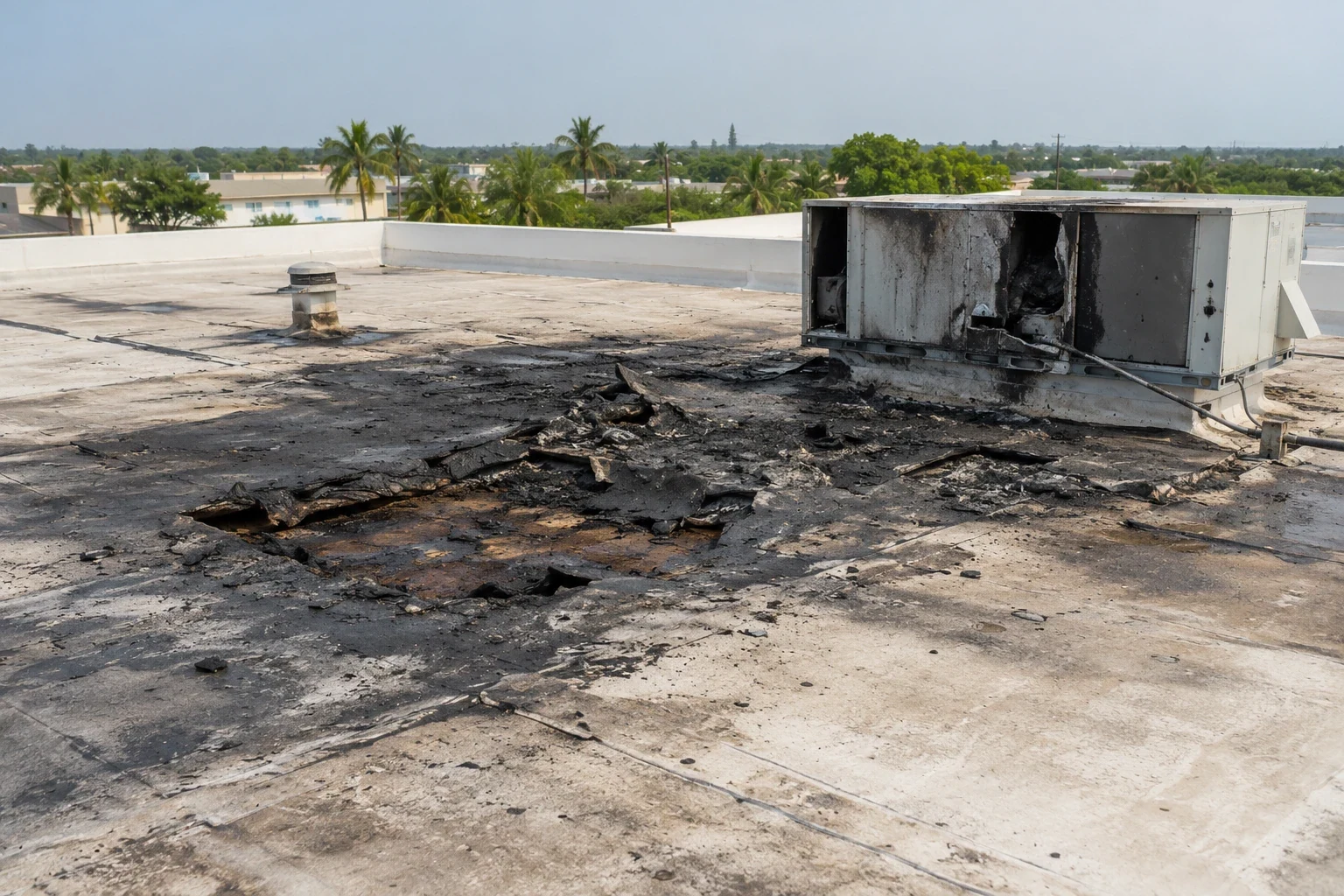
Seam Failure Repair in Pembroke Pines, FL
Seam failure repair for Pembroke Pines, FL commercial roofs: probe testing, weld and lap diagnosis, cover strips and a repair boundary tied to moisture.
An open seam with clean edges and dirt inside the gap has been moving for a season, not a day. That finding tells us the failure is progressive, so the first repair question is how many other seams share the condition. For an owner in Pembroke Pines, FL, a single open lap supports a contained repair, while a run of them across a section points to a membrane or an installation problem that patches will not cure. Heat and wet-season storms act on seams every day, and the pattern we find decides whether the next decision is a cover strip, a re-weld or a capital item. We start by testing the whole section, not only the lap that leaks.
Probe every seam in the section
A seam can look closed and still be open. We walk the section with a rounded probe and test each lap and splice, pressing along the edge to find places where the probe enters. Open areas are marked with chalk and photographed. We record the length and location of each on the roof plan.
The map shows the pattern. Open seams clustered at one side of the roof may follow the sun and the direction of movement. Open seams along a single run may trace to one installer's work or one batch of material. Scattered openings across the roof suggest aging. The pattern defines the repair boundary and informs whether a targeted repair is enough.
Probing is slow work, but it is the only test that finds the gap before the water does. We keep the probe rounded so it will not cut the sheet, and we work at a steady pace along each lap so no stretch is skipped.
Tell shrinkage from poor welds
Seams open for several reasons. The membrane may have shrunk and pulled the lap apart. The weld may never have fused fully, because of dirt, moisture or incorrect temperature. The adhesive may have aged and lost grip. Movement at the substrate may have stressed the joint.
The edges tell the story. A clean, shiny edge suggests a weld that never bonded. A pulled-back sheet at corners and walls suggests shrinkage. A seam that has opened along a joint in the deck suggests substrate movement. Heat plays a part in all of them. The Pembroke Pines weather station records July normals of 91 to 92 degrees for daily highs, and a roof surface runs well above air temperature, so every lap flexes through a hard daily cycle.
Penetrations and corners get a closer look because seams there are made by hand with small patches and tight radii. A field-cut corner is more likely to open than a straight run of factory-made lap.
Choose the repair by membrane type
The right repair depends on the sheet. Thermoplastics such as TPO can be re-welded or covered with a heat-welded strip. EPDM seams use tape or splice adhesive and a cover strip. Modified bitumen laps are re-heated or covered with compatible patch material. Each system has its own preparation: cleaning, priming, probing and curing.
We identify the membrane first, by markings, thickness and behavior. Then we choose the method and materials that bond to it. A mismatched product may adhere for a few weeks and then peel, which wastes the repair and hides the cause. Where the existing sheet is too aged to weld, a cover strip over a prepared surface becomes the practical choice.
Where the surface itself shows chalking and cracking along with the openings, the heat is the underlying cause, and the plan pairs the seam work with heat and UV damage repair so the same cause is not left in place.
Cleaning is the unglamorous step that decides most repairs. Dirt, algae, grease and old sealant must come off before any new material goes on. We use the cleaner and primer the membrane maker recommends, and we let each cure before the next step.
Check what water already reached
An open seam is a path for water, and the insulation under it may already be wet. A moisture survey and a few cores show whether the problem ends at the seam or extends beneath it. Wet insulation under a repaired seam holds water against the deck and softens the new bond.
When the survey finds wet material, the repair includes its removal and replacement, followed by the seam work. The infrared moisture survey sets the boundary for that removal. Water in the South Florida wet season, which brings near-daily showers between May 15 and October 15, finds any open seam quickly, so the moisture check comes before the cover strip, not after.
Cores also reveal whether the seam was made over a wet or damaged board. A seam over a soft board will open again, so the board is repaired with the seam.
Decide whether the pattern ends the repair
Repeated seam repairs have a limit. If the second or third round of repairs is opening new seams beside the old ones, the membrane is telling us it has reached the end of its service. A section with more than a few scattered openings after a clean-up may be better handled by a restoration coating, if the substrate is dry and the sheet is sound, or by replacement of that section.
We present these options with costs, expected service life and the conditions that favor each. The owner can then choose between another repair cycle and a capital item with the evidence in hand. A recommendation to stop repairing is part of the finding when the data point that way.
Replacing a section can cost less than the sum of several seam repairs and the interior damage they allow. The comparison is part of the proposal, with each cost listed so the owner sees how the numbers move.
Record seam locations for the next walk
The closing record lists each repaired seam by location and length, with before-and-after photographs and the products used. A follow-up probe after the first hot summer shows whether the repairs hold. Owners with buildings in the Chapel Trail area or the SW 145th Avenue office corridor can keep every building in the same format, and a flashing failure repair can be logged beside the seam work when both appear in the same walk.
Buildings across Miramar, Davie and Hollywood often follow the same seasonal calendar, so one probe schedule, set for the weeks after the first hot stretch and again before the stormiest wet-season phase, works across a portfolio.
Commercial Roofing Questions
How can an owner tell whether a seam is open or only looks open?
Probe it. A rounded tool pressed along the edge will enter an open lap but not a bonded one. We test the whole section, mark openings and photograph them, since seams that look closed can hide gaps.
Why do seams open in the first hot summer after installation?
A weld or adhesive bond that never fully fused can hold until heat cycling pulls on it. Dirt, moisture or low temperature at installation often explains it. A probe test after the first summer catches these before water enters.
Is a cover strip as good as a re-weld?
A properly prepared and welded or adhered cover strip can restore a seam for years. A re-weld works when the sheet is clean and flexible. When the membrane is aged or contaminated, the cover strip is more reliable.
How many seam repairs are too many before replacement?
There is no set number. If new openings keep appearing beside repaired ones, or if wet insulation spreads, the membrane has reached its limit. We count the repairs and map them to show whether a pattern points to replacement.
Does wet insulation affect a seam repair?
Yes. Wet insulation under a seam softens the bond and can reopen it. A moisture survey and cores identify it, and the repair includes removing wet material before sealing the seam.