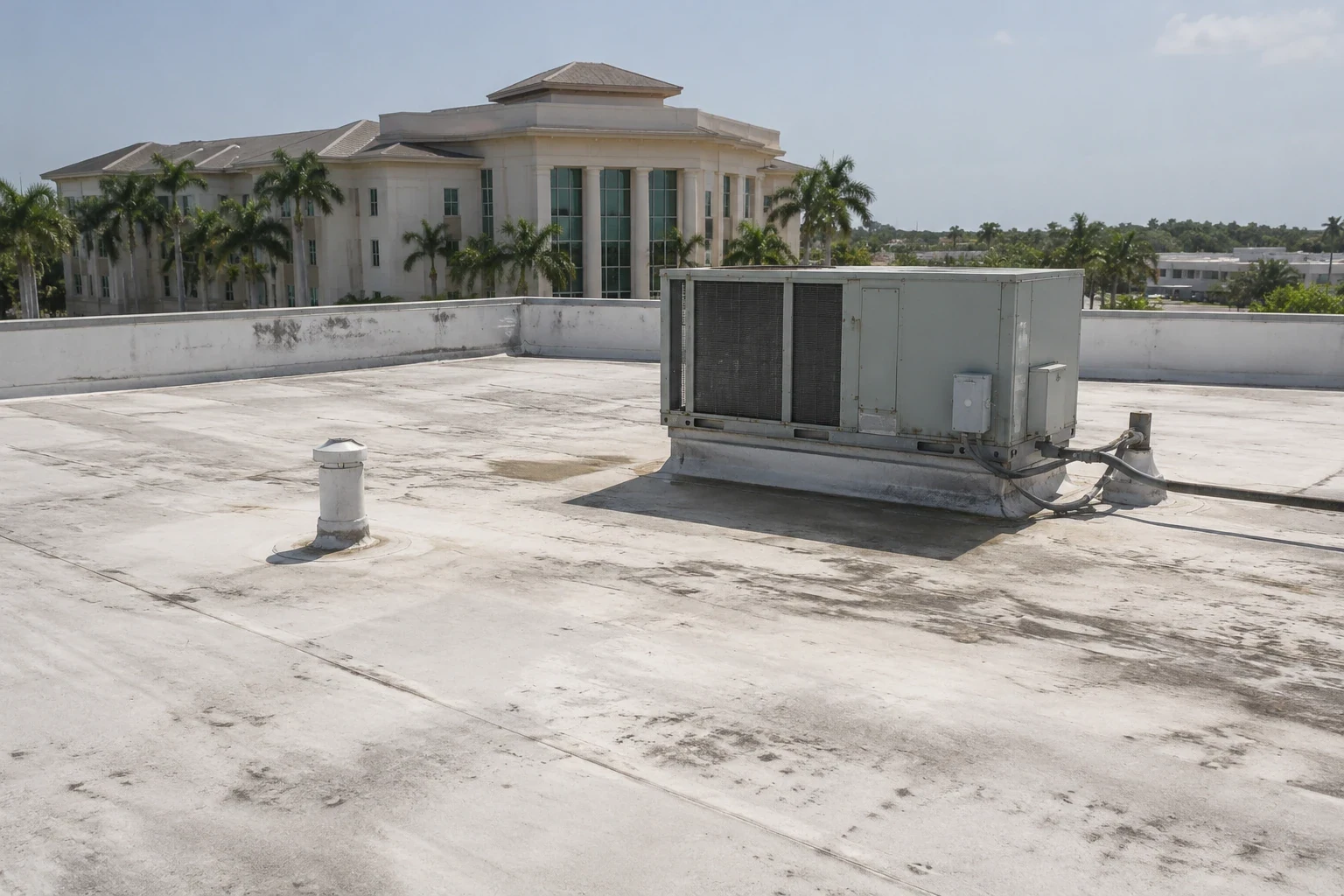
Ponding Water Roof Repair in Pembroke Pines, FL
Ponding water roof repair in Pembroke Pines, FL: depth and duration measurements, drain and slope diagnosis, tapered insulation options and wet-season planning.
Water still standing on a roof two days after rain is a drainage finding, not a weather event. In South Florida, where the wet season brings near-daily showers and thunderstorms, a roof that holds water never gets a long dry spell to recover, so small ponds age seams and load the deck through the whole season. For an owner in Pembroke Pines, FL, the inspection question is why the water stays: a low spot, a high drain, a blocked outlet or a crushed layer of insulation. The answer changes the repair from a clean-out to a tapered insulation correction, and it shows whether the membrane under the pond has already been harmed.
Measure how long the water stays
Depth and duration separate a nuisance from a defect. A film that dries within a few hours is normal for many low-slope roofs. A pond several inches deep that remains the next day is a problem. We visit after rain, or run a hose test on a dry day, and record where water collects, how deep it is and when it clears.
The measurements go on a plan with arrows showing the intended flow. Comparing the intended path with the observed one shows where the roof departs from its design. Without that comparison, a repair can address the wrong location and leave the pond in place. The record also becomes the baseline for judging whether a correction worked.
A hose test on a dry day complements the rain visit. We run water at the upper end of a suspect area and time how it travels, which shows slow spots that a single rain event can hide and lets us repeat the test after the repair.
Find the cause of the low spot
Ponds form for a few common reasons. The deck may have deflected under load or age. Insulation may have compressed under equipment or foot traffic. The roof may never have had enough slope toward its drains. A drain may sit higher than the surrounding field, or a build-up of old layers may have raised the surface around it.
We check each by measuring elevations with a level or laser, probing the insulation for softness and reviewing the structure where deflection is suspected. When the deck is in question, we recommend an engineer's review before any new weight goes on. Many ponds trace back to the insulation, which is why a tapered insulation and cover board correction is common in replacements.
Equipment loads often explain a local dip. A unit set on the deck without a spreader, or a stack of stored material left for months, can crush insulation and leave a basin that persists long after the load is gone.
Check drains, sumps and overflows
A blocked or partly blocked drain turns an ordinary pond into a persistent one. Leaves, silt, gravel and trash collect in the sump, and a crust of fine sediment can seal the strainer. We clear the drain, test flow with water and look at the pipe below the roof when the flow is slow.
Overflow openings matter as much as primary drains. If the overflow scupper is clogged or set too high, water rises before it escapes. Our review of drains and scuppers checks the height, the size and the condition of each outlet. Adding a drain at a low spot, or resetting an existing sump lower, is often the most direct correction when the field is otherwise sound.
Roof-mounted equipment can also dam the water. A pipe stand, a duct run or a curb set across the drainage route turns a drainage path into a pond. A small saddle or a raised support often cures the problem without touching the field.
Plan around near-daily wet-season rain
Most of the region's yearly rainfall, 60 to 70 percent of it, falls between mid-May and mid-October, so a low area that holds water has little time to dry out between storms. A repair to a ponding area has to fit between those storms.
Tapered insulation requires removing roof sections, so each opening is limited to the area the crew can seal before rain arrives, with covers and sealant already on the roof. Where a correction can wait for drier months, we say so and set an interim plan: clear the drains, patch any open seam and monitor depth. The stormiest weeks of mid-May through early July are poor times to open large areas for slope correction.
Cover board and tapered insulation add some weight, so the deck is checked first. Where the structure is marginal, the correction may use lighter materials or a different slope plan.
Repair the membrane under the pond
Standing water shortens the life of the sheet under it. Algae grow, dirt collects, seams soften and some membranes swell at the edges of the pond. We inspect the surface within the wet area, probe the seams and look for blistering or pinholes.
If the membrane is sound, cleaning and a drainage fix may be enough. If seams are open, a seam failure repair comes first. If the sheet is punctured, a membrane puncture repair follows the same boundary logic. Wet insulation under a pond is removed and replaced, because it holds water against the deck and loses its thermal value.
Interstate 75 and US 27 corridors see the same rain as the rest of the city, but flex and warehouse roofs with large, flat fields collect more total water, so their drains work harder in a single storm.
Record depth and duration for the next review
The closing record lists the pond locations, depths, durations and the correction made at each. Photographs after rain show the result. Owners with flex and warehouse buildings in the Chapel Trail area or in the northwest industrial area can compare roofs on the same measurements, and owners near Miramar or Hollywood can do the same. A follow-up check after the first heavy rain confirms that the water now leaves the roof as planned.
Cost drivers are plain: pond area, depth of wet insulation, the number of drains added or reset and the season. The proposal shows each one, so the owner can see how the number moves when the scope changes.
Commercial Roofing Questions
How long should water stay on a flat commercial roof after rain?
A thin film that dries within hours is usually acceptable. Water that remains for a day or more is worth correcting. We measure depth and duration, compare them with the drain layout and decide whether the cause is a low spot, a high drain or a blockage.
Can ponding be fixed without replacing the roof?
Sometimes. Clearing a drain, resetting a sump or adding an outlet can solve a localized pond. Persistent ponds over compressed insulation may need tapered insulation in that area. The cause, found by measurement, decides which approach applies.
Does standing water void a roof warranty?
Many manufacturer warranties limit coverage for ponding beyond a stated depth or duration. Terms vary, so we read the warranty first and document the ponding before any repair. The record shows what existed and what was corrected.
Why does ponding get worse in the wet season?
Near-daily rain gives the roof little time to dry between storms, so small ponds persist and grow. Debris also accumulates faster. Clearing drains before May 15 and checking again after heavy storms limits the problem.
What does tapered insulation do for a ponding roof?
It builds slope into the roof, directing water toward drains. It is installed beneath a new membrane, so it usually accompanies a replacement or a major section rebuild. Cover board above it gives the membrane a stable surface.