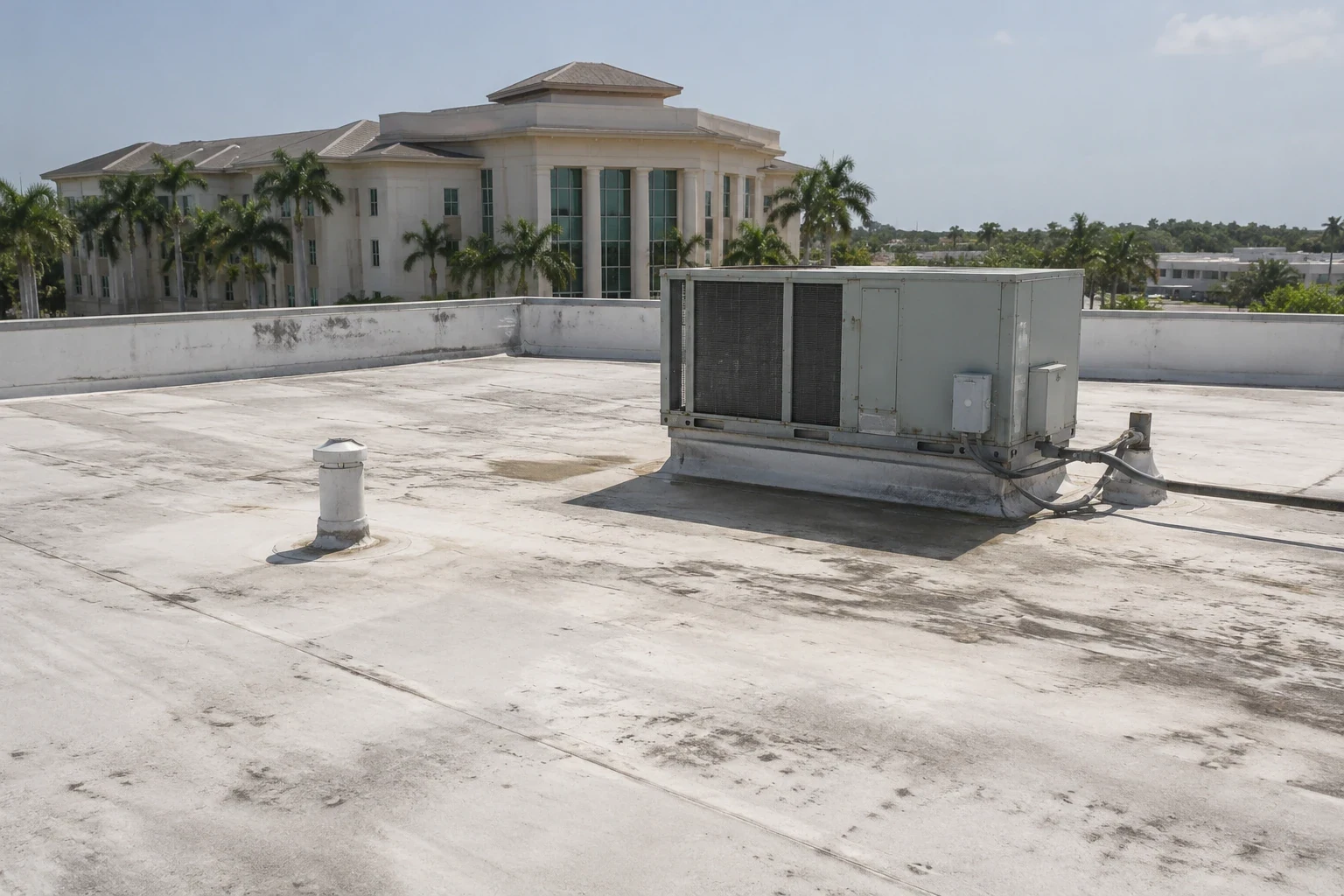
Roofing for School Districts in Pembroke Pines, FL
Roof inspection, summer-window replacement and capital planning for school districts in Pembroke Pines, FL, built for the wet season and opening day.
A roof opened in July has to be closed by afternoon, because the summer break and the South Florida wet season occupy the same weeks. That overlap is the central finding for a school district in Pembroke Pines, FL. The summer break that frees classroom roofs for crews falls inside the wet season, which runs from mid-May to mid-October with near-daily showers and thunderstorms. A district's roof plan therefore has to answer two questions at once: what must be done before opening day, and how much roof can be exposed on a given afternoon. We start with the inspection findings and build the schedule from the limits they set.
Count the weeks before opening day
Work backward from the first day of school. Subtract the time for final inspection and punch list, the days lost to weather, the lead time on materials and the time needed for permits. What remains is the real window for tear-off and installation, and it is shorter than the calendar suggests.
We lay this out for the board or facilities office early, with a fixed scope for the window and a list of items that can wait for a holiday or weekend. Projects that start late in the summer risk carrying open sections into the first week of classes, which no district wants. A realistic count in March prevents a rush in July.
Materials deserve their own line. Membrane, insulation and metal trim ordered in March arrive in June, and substitutions need approval under the permit. Keeping the order and the approval list in one place prevents a delay that nobody sees until July.
Rank roofs by what they cover
A gymnasium, a media center, a cafeteria and a classroom wing carry different consequences when water gets in. Electrical rooms, server closets and kitchens add more. We rate each roof section by what lies beneath it and by its condition, so the limited summer window goes first to the roofs where a failure would cost the most.
A moisture survey before the summer separates sections with wet insulation from sections that need only seam work. That prevents the common mistake of replacing a sound roof because it is old while a wet one waits. The ranked list becomes the district's priority order for the year and the basis for the next budget request.
Interior checks by the district's own staff add speed. Facilities teams know which rooms leak after which storms, and a short walk with them before the survey points us to the sections worth probing first.
Use the summer window for the largest scope
Summer break is the time for tear-off and replacement above classrooms. Holiday breaks and long weekends suit smaller repairs. During the school year, only emergency repairs and exterior work away from students should proceed.
We organize the replacement by building and section, so a campus can hand over finished wings progressively instead of waiting for a single completion date. Temporary protection stays on every open section, and a spotter confirms the area is dry at day's end. For a district with school roofing across several campuses, the order of campuses follows the ranked list, with a reserve of time for weather delays.
A handover checklist for each wing lists the final moisture readings, the photographs of every flashing and the warranty registration. The district signs for each wing, and the next wing starts only after the last one passes.
Rooftop units on classroom wings add condensate lines and curbs, and cafeterias add kitchen exhaust. We list them in the survey with their condition, because a unit swap planned for the same summer should be coordinated with the roof scope instead of following it.
Plan for afternoon storms and hurricane season
The earliest weeks of summer bring the worst of the storm hazards, including damaging wind, tornadoes, lightning, hail and flooding, and tropical systems become a concern again from August through October. A summer project spans most of that calendar.
Daily openings are limited to what can be sealed before afternoon storms, and the crew leaves the roof when lightning nears. The hurricane zone and the 2023 code edition shape the assembly, the permit forms and the product approvals, and all three are settled before a contract is signed. Roofs finished before late summer give the district a dry building when the peak of hurricane season arrives.
Projects within reach of Interstate 75 and the nearby city of Miramar draw on the same pool of crews and trucks, so early booking matters for a district that wants its first choice of start date.
A phased handover also helps with insurance. Each wing that passes its moisture check and final inspection is documented and released, so the district's coverage questions have a clear answer for every building by the time classes resume.
Protect students and staff during partial work
Some work cannot wait for summer. Emergency repairs and small sections happen while students are on campus. In those cases, fenced work zones, covered walkways, clear drop-off and pick-up routes and no overhead lifts during arrival or dismissal protect the campus community.
We coordinate with the principal and facilities office on notices, noise and odor limits near testing days. Wherever a campus sits in Pembroke Pines, deliveries are timed away from buses and parent traffic. Colleges and trade schools use a similar approach, and the college and university plan adjusts for residence halls.
Lightning stops roof work immediately. Crews descend, secure loose material and wait out the cell. That rule is written into the schedule, so a district can see the likely number of lost afternoons in a normal summer.
Gutters, scuppers and covered walkways need a check before the first big storm of the season. A clogged outlet above a walkway can pour water onto students, so those drains are cleared and tested at the start of every summer project.
Hold one file for the board and the state
A district answers to a board, a budget office and often state reviewers. A roof file with survey results, repair logs, photographs and warranty status serves all of them. A multi-site roof program keeps every campus in the same format. Public agencies that run other civic buildings, and health systems with campuses of their own, can use the same file structure for a combined capital view.
Each board update shows what was completed, what is planned and what changed, with dates and photographs.
Commercial Roofing Questions
How much roof can be opened in a summer afternoon in South Florida?
Only the area that can be sealed ahead of afternoon rain, usually a modest section. The wet season brings near-daily showers and thunderstorms, so we size each day's opening to the forecast and keep temporary protection staged on every open area.
When should a district start planning a summer roof project?
By the preceding winter. That allows time for surveys, scope, budget approval, permits and material lead times. A project that starts planning in May often runs out of calendar before the work begins.
What if the roof is not finished by the first day of school?
The plan builds in a reserve for weather and phases handover by wing. Any section that remains open is protected and sealed, and the finished sections are released to the campus. We discuss the contingency before the contract is signed.
Can a school roof be repaired during the school year?
Yes for emergencies and small sections, with fenced work zones, no overhead lifts during arrival and dismissal and limits on noise near testing. Larger projects are better held for summer.
How does the hurricane zone affect school roof projects?
Zone rules call for particular permit forms and approved products on a district reroof. We confirm the permit scope with the city, and the finished documents go into the district's file.