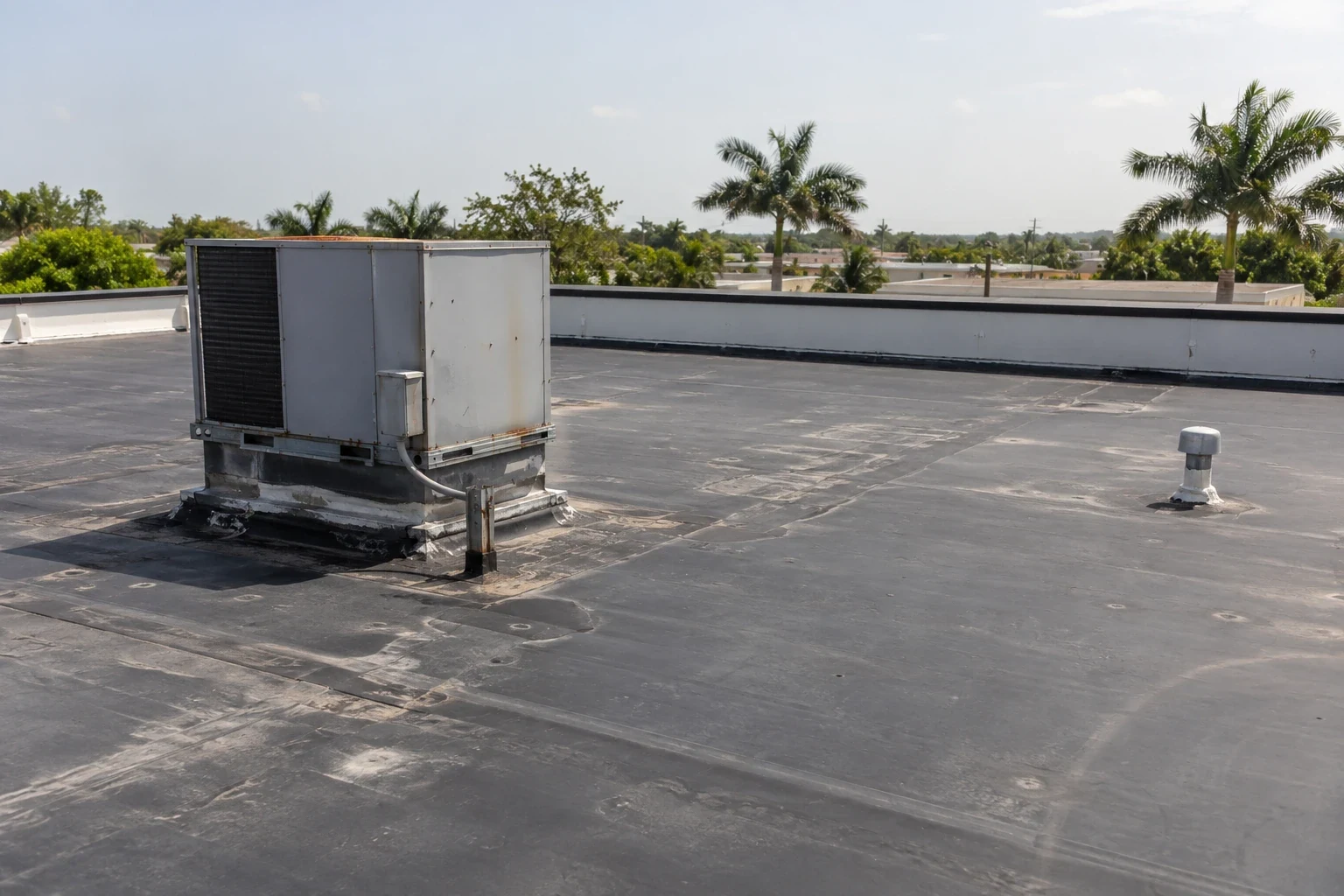
Built-Up Commercial Roofing in Pembroke Pines, FL
Evaluate built-up roofing in Pembroke Pines with ply condition, surfacing review, selective openings and a defined repair or capital replacement scope.
A split beside an intact-looking built-up roof surface can involve several plies beneath the visible opening. The repair decision needs to establish those layers and their condition before another surface treatment is selected. In Pembroke Pines, FL, we examine built-up roofing as a layered assembly with specific retention questions. The owner should understand how far the correction must reach and what material remains suitable beside the defect.
Built-up roofs use multiple reinforcing plies with asphalt or another specified bituminous component and an appropriate surface treatment. The exact construction matters for investigation and repair. We identify the installed arrangement and assess its details before proposing work. A comparison with modified bitumen roofing should distinguish those assemblies rather than treat their asphalt-based surfaces as proof that the same correction fits both.
The layers need an examined boundary
A surface split may require investigation of the plies and insulation below it. The opening can reveal affected material, previous repairs or a different construction than records suggest. We identify the condition that makes further examination necessary and plan how the roof will be closed after it. A removal boundary should reach suitable material for the reconstructed assembly rather than stop automatically at the visible crack.
A localized correction also needs an assessment of adjoining condition. Distributed deterioration can make another isolated repair less useful even where the original opening is small. We compare those findings with a defined roof repair package and broader capital work. The asset manager should know whether the proposal corrects a compact defect or is one limited intervention within a roof requiring another decision.
Surfacing protects a specific construction
Aggregate, coatings and other surface treatments have different relationships to the assembly beneath them. We examine their condition and the material they protect rather than assume that a uniform surface establishes a sound roof. Displaced aggregate or a weathered finish can require attention, but the repair recommendation should also identify whether the underlying plies remain suitable. The visible covering should not obscure that question.
Surface preparation for a correction needs to suit the installed roof and selected materials. An old repair compound or unsuitable coating can complicate the new connection. We identify removal and preparation necessary to establish an acceptable area. Adding material over an unidentified treatment can leave the repair dependent on a weak interface even where the finished surface appears continuous.
Blisters and ridges need interpretation
Raised areas can involve adhesion or movement conditions requiring assessment. We examine their extent and relationship to water paths and adjoining details before choosing an action. A finding may justify selective investigation rather than immediate broad removal, while another may compromise the connection supporting a repair. The recommendation should explain the observed concern instead of prescribing one response to every surface irregularity.
Where moisture is suspected, an appropriate moisture investigation can help direct confirmation. Roof construction and surface coverings can affect the usefulness of a thermal method. We evaluate suitability before recommending it and distinguish indications from confirmed affected material. The owner needs a defensible retention or removal decision, not an image whose apparent boundaries are presented as a complete assessment without examination.
The vertical details need support
Parapets, equipment curbs and penetrations require a suitable transition between the layered roof and adjoining components. Movement and deficient support can concentrate stress at flashing corners or terminations. We inspect those relationships and identify where reconstruction is necessary. A new surface ply should not be used to bridge an unanswered support question at a component that continues to move.
Finished roof height matters when insulation or another assembly is added. Curbs, drains and perimeter details must be reviewed against that proposed elevation. We discuss those changes before choosing retention or a PVC replacement assembly. The material comparison should include the construction needed at those interfaces rather than select a different membrane while leaving the existing geometry unresolved.
Rain and occupied use guide preparation
South Florida's wet season brings recurring showers and thunderstorms from mid-May through mid-October. Roof openings and application methods need a sequence that protects exposed insulation and supports suitable material preparation. We evaluate the forecast and the work required to complete temporary or permanent connections before deciding how much assembly to remove. Additional concealed correction can require a smaller daily package than the original surface view suggested.
Installation methods also have operating implications. Heat-based or other bituminous applications require the preparation, precautions and conditions appropriate to the selected system. We discuss occupied rooms, air intakes and sensitive activities where they affect the work. The recommendation should identify those constraints before construction so the owner's schedule and the assembly's installation requirements remain compatible.
Local properties need distinct phases
Office development within the SW 145th Avenue Office Corridor creates practical questions about equipment serving tenants and protected space beneath removal. We identify the roof area involved and the personnel needed for any coordinated shutdown or access. A layered repair can require more preparation than its visible footprint implies. The occupied-space plan should reflect that work rather than assume a small exterior defect has no consequence below.
Chapel Trail includes warehouse and flex uses, where stored goods and loading schedules can alter staging. A project in the Chapel Trail commercial area needs an appropriate route for removed material and protection beneath selective openings. The area's industrial uses provide an operating context, while the inspection establishes the actual roof construction. We keep those questions separate when defining the work package.
The capital choice follows the extent
Localized repair remains a reasonable consideration where the adjoining assembly provides a suitable connection and support. Widespread affected insulation, unsuitable layers or distributed ply deterioration may support broader removal. We explain that extent and any remaining investigation needed before the scope is finalized. The owner can then compare another repair with replacement using the same construction findings rather than different assumptions about concealed condition.
A maintenance program for retained roof areas should track drainage, flashing movement and later equipment work. Closeout records need to distinguish retained construction from newly installed components. Photographs during repair can preserve layer and substrate findings that later become concealed again. That information gives the asset manager a useful starting point for the next assessment instead of an undifferentiated record that says only the built-up roof was repaired.
Commercial Roofing Questions
Does a surface crack mean every ply has failed?
The visible opening needs examination of its depth and supporting material before that conclusion is made. Some defects can support a localized correction, while others reveal deterioration through several layers. We identify what the assessment establishes and where further investigation is needed. The repair boundary should follow suitable construction and the observed condition rather than assume that surface appearance defines every affected ply.
Should displaced aggregate be replaced immediately?
The surfacing and underlying assembly need assessment to identify the appropriate response. We examine the area, its water path and the condition exposed beneath the covering. Surfacing correction may be part of maintenance or a defined repair package. The proposal should explain that relationship instead of treating restoring appearance as proof that the concealed roof remains suitable.
Can a coating be applied over the built-up roof?
Restoration requires a suitable retained assembly, compatible preparation and a system appropriate to the actual surface. Affected material and active defects need correction first. We examine those conditions and compare the preparation package with other work. A coating can be considered where the roof supports it, but it is not a replacement for investigating concealed deterioration or reconstructing deficient flashing.
What helps compare repair with a new assembly?
Establish the extent of unsuitable layers, moisture and detail correction, then compare the work each option needs. We identify what a limited repair would resolve and what it would leave for later attention. Replacement can be justified where those remaining conditions are substantial. The useful decision follows the full construction scope rather than the visible surface treatment or a general preference for another material.