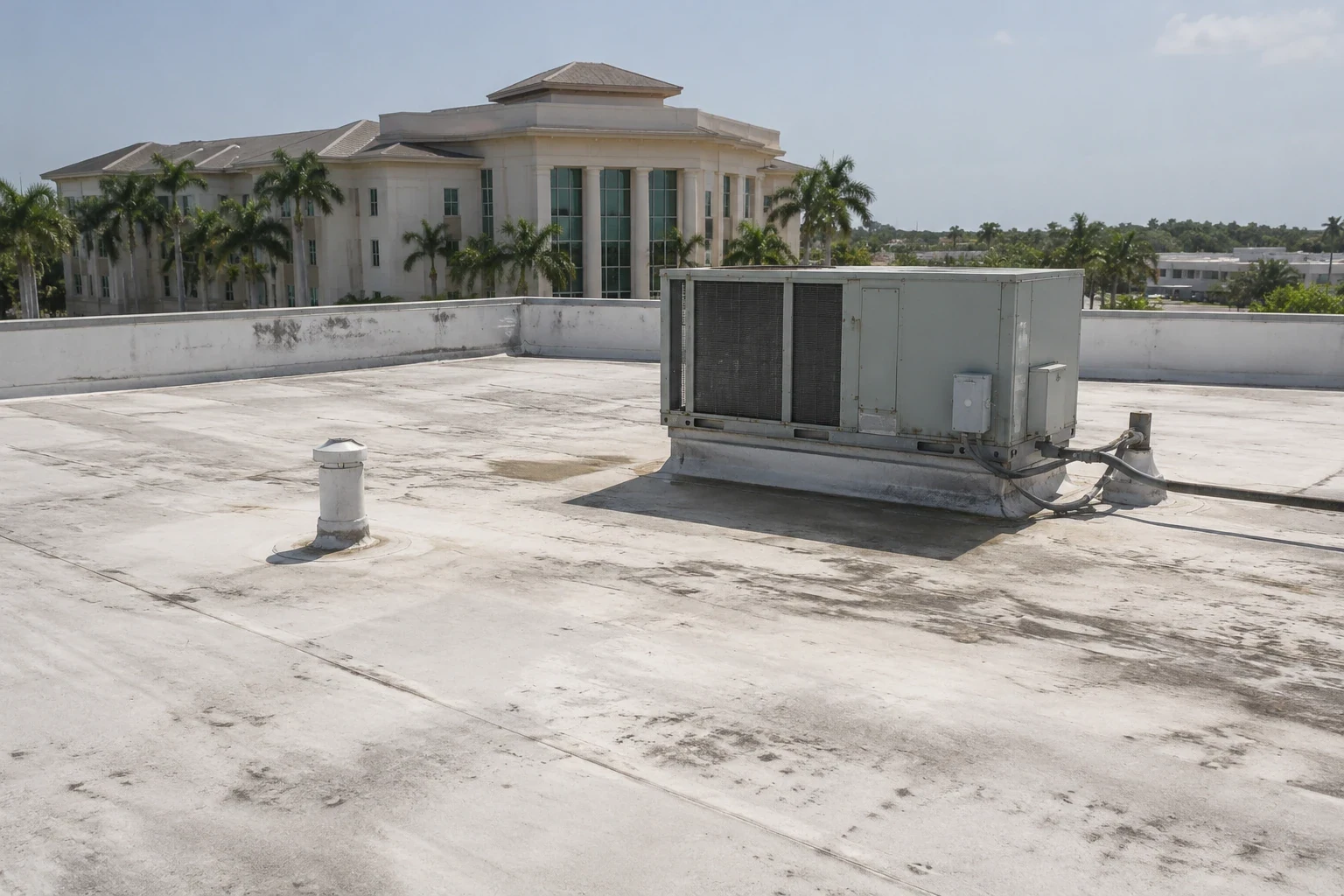
Roofing for Insurance Adjusters and Restoration Contractors in Pembroke Pines, FL
Storm damage documentation, repair boundaries and code-aware scopes for adjusters and restoration contractors on commercial roofs in Pembroke Pines, FL.
A claim file that cannot separate storm damage from age gets settled at the lower number. The roof may show cracked coating, bruised membrane and wet insulation, but unless each finding is tied to a location, a date and a cause, a reviewer has no reason to credit it. For adjusters and restoration contractors working on commercial roofs in Pembroke Pines, FL, we document in a form that carries those links. The city's own consolidated plan identifies historical exposure to flooding, heavy rain, tornadoes and hurricanes, which is context for the file and not proof of damage to any roof. Evidence from the roof itself has to do that work, and we gather it in a way a carrier can follow.
Record the roof before the storm
The strongest damage claim rests on a baseline. A dated photo set, a moisture survey and a condition report taken before the event show what the roof was like and what changed. For owners with a maintenance program, those records already exist.
We encourage owners to keep them current, especially before the wet season starts on May 15 and again before the peak of tropical-system months in August, September and October. When a storm arrives, a post-event walk compares the roof with the baseline photograph by photograph. Where no baseline exists, we document age indicators, past repairs and the pattern of damage, so the file shows what can and cannot be tied to the event.
Neighboring conditions can help. Where a storm's path is documented by weather service reports or by damage on adjacent buildings in Miramar, Hollywood or along Interstate 75, those reports can be cited as context, though the claim still turns on the roof in front of the adjuster.
Separate storm damage from wear
Roofs age, and age leaves marks that resemble storm damage. Blistering, alligatoring, ponding stains, UV chalking and old repairs can all appear in a file photograph. Hail leaves round bruises with granule displacement or fractured coatings. Wind leaves lifted laps, displaced edge metal and directional debris. Lightning leaves scorching and punctures.
We mark each finding with its type, location and the evidence for its cause, and we say which findings we attribute to age. That clarity strengthens the rest of the file. A reviewer who sees wear acknowledged is more likely to accept the damage that is claimed. Each pattern is scoped on its own terms, whether the work is hail damage repair or wind damage repair.
Photograph scale and angle matter. A coin or ruler in frame, a shot along the surface and a close view of each mark let a reviewer judge size and direction without a visit, and they make the file useful to a second adjuster.
Tornado and hurricane events add structural questions. If deck, framing or large areas of membrane have been displaced, the file includes an engineer's assessment before any repair is priced.
Protect the building first
Mitigation comes before the dispute. An open roof or a wet interior gets temporary protection immediately: tarps fastened through battens, sealed penetrations and interior containment. Our emergency roof repair response covers this step at any hour, and we photograph the roof before anything is covered.
Carriers expect owners to prevent further loss, and a proper temporary cover does that. We keep receipts, photographs and a log of what was done and when, so the cost of mitigation is documented with the claim. If a storm has caused structural damage, the roof area is closed until an engineer has assessed it, and we say so in the file.
Interior damage is part of mitigation too. Wet ceiling tile and insulation are removed and dried within days to limit mold, and the contractor logs moisture readings with the date so the interior scope matches the roof scope.
When the carrier sends an adjuster, a prepared roof walk saves a day: access is open, the plan is in hand and the contractor can show each finding with its photograph. That readiness shortens the path from loss to approved scope.
Scope the repair boundary for the review
The estimate should say what is being repaired, what is being replaced and why. A moisture survey and cores define the extent of wet insulation. The removal boundary is drawn on a plan, with quantities for membrane, insulation, flashing and edge metal.
Where the damage is limited to a section, the scope says so, and a storm damage roof repair package is priced for that section. Where the damage is widespread, the scope explains what pushed it there. Both adjusters and restoration contractors benefit from a scope that can be audited line by line. We attach unit prices for items such as deck repair, so supplements can be evaluated against a stated rate.
Unit prices are the second half of the scope. Per-square-foot figures for insulation, deck repair and flashing let a supplement be reviewed as a count of units, not as a new negotiation.
Account for code items in the estimate
A claim scope in this city is written against the 2023 Florida Building Code edition, and the High Velocity Hurricane Zone designation applies to the property. City permit resources include a commercial reroof statement for the zone, insulation certification and rooftop equipment forms. A repair or replacement may therefore trigger permit requirements and product approvals that affect cost.
We list those items separately in the estimate and confirm the permit scope with the city before pricing. With a newer edition due at the end of 2026, a claim that crosses that date should record when the permit was issued. A scope that names the governing edition reduces later disagreement over what the code requires.
Lead times on approved products can affect the schedule, and the file notes any that delay permanent work, so a carrier sees why temporary protection stays in place.
Close with a file the carrier can read
The closing package includes the baseline comparison, the damage map, the mitigation log, the scope, the permit documents and completion photographs. Each is labeled by roof section. Restoration contractors can pass it to the adjuster as it stands. Property managers and public agencies keep it with the building record, and a Pembroke Pines owner with several buildings can use the format across all of them. Our claim assistance follows this structure.
A final cover sheet lists the documents by section so a reviewer can move straight to the evidence for any line item.
Commercial Roofing Questions
How does an adjuster tell hail bruising from blistering or wear?
Hail bruises are round, often with displaced granules or a fractured coating, and cluster with a direction. Blisters are raised and soft, and wear shows as chalking or cracking across the surface. Photographs with a scale, plus cores, separate the two.
What should a restoration contractor document first?
The roof as found, before anything is covered or removed, with dated photographs tied to a plan. Then the mitigation steps and receipts. These two records set the foundation for any later scope and supplement.
Does a roof need to be replaced after a hailstorm?
Not automatically. The extent of damage decides. A moisture survey and cores show whether insulation is wet, and the inspection shows whether the membrane is compromised. Limited damage supports a section repair, and widespread damage supports replacement.
How does the hurricane zone affect claim estimates in Pembroke Pines?
Repairs and replacements often involve specific permit forms and product approvals under the Florida Building Code, 8th Edition (2023). Those items add cost and time, so we list them separately in the estimate.
What records strengthen a commercial roof claim?
A pre-event baseline, post-event photographs, moisture survey results, a repair log and the mitigation record. Labeling each item by roof section lets the reviewer find the evidence for every line of the estimate.