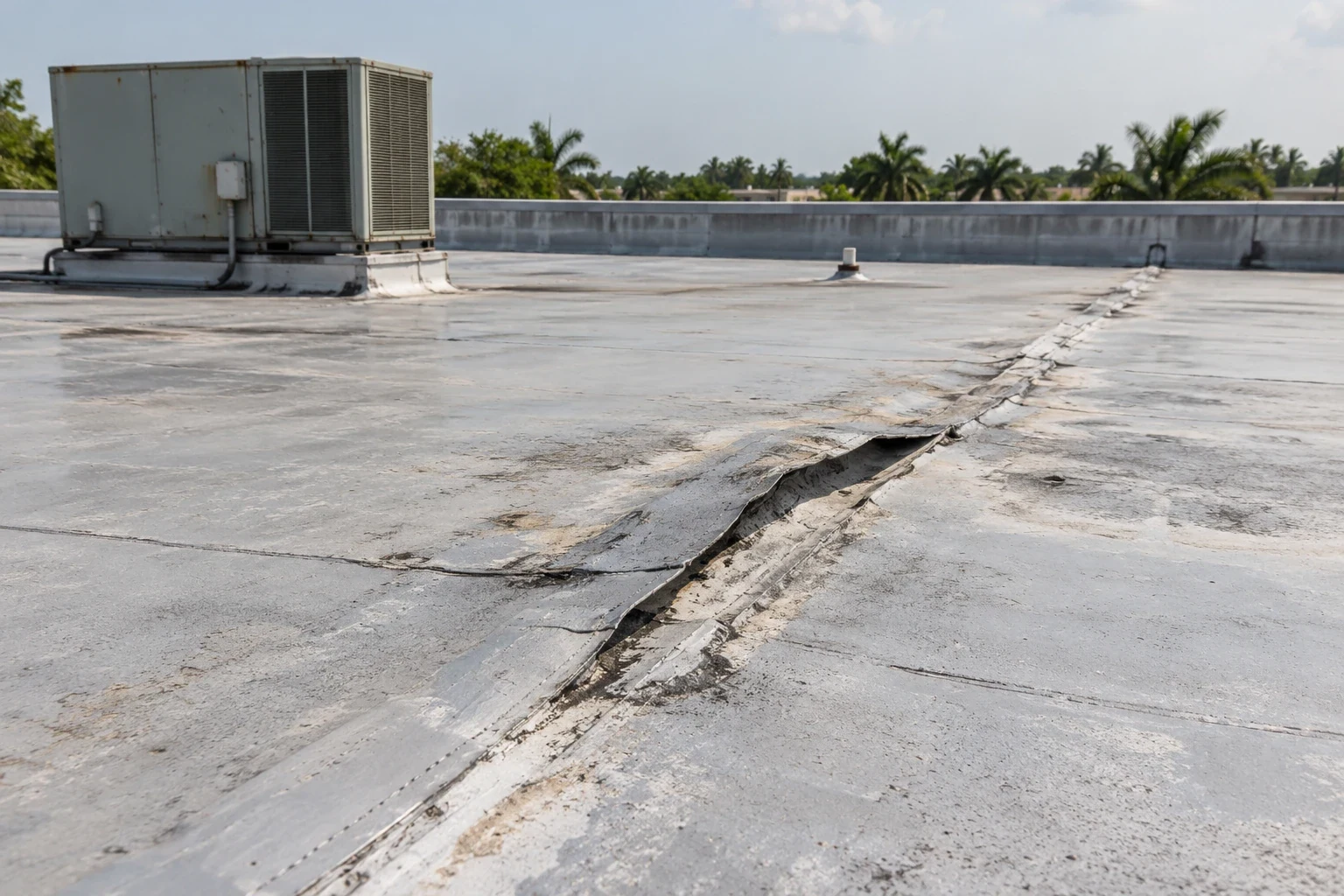
Heat and UV Roof Damage Repair in Pembroke Pines, FL
Heat and UV roof damage repair in Pembroke Pines, FL: surface wear grading, flexibility testing, coating or replacement decisions and reflective options.
Chalking on a roof surface is a measurement of how much sun the membrane has already absorbed. A fine white powder on the finger, a loss of sheen and a faint crazing at corners tell us that the top layer is wearing and that the layers beneath will be exposed if the process continues. For an owner in Pembroke Pines, FL, the question is how far the wear has gone and whether the membrane still bends, bonds and seals. The Pembroke Pines weather station records July daily maximum normals of 91 to 92 degrees and minimums of 77, and the National Weather Service notes that July and August heat index values can reach or exceed 100. Heat is steady here, and so is the wear.
Read the surface wear
We grade the surface in stages. Light chalking and color fade are cosmetic. Loss of surface granules or top film, visible reinforcement scrim and fine cracking are structural. We rub the surface, photograph the condition and compare sun-facing areas with shaded ones to see how much of the wear is exposure.
The grade sets the next step. Surfaces in the early stages can often be cleaned and recoated. Surfaces with exposed scrim or deep cracks cannot be saved by coating and need repair or replacement. Because wear varies across a roof, we grade each section separately. A south-facing slope or an area under reflected heat from a wall can be a stage worse than the rest.
A small test patch of cleaner on the surface shows what lies beneath the dirt. Sometimes a roof that looks worn is only dirty, and a wash restores much of its color and reflectivity before any coating is considered.
Test flexibility at seams and corners
Heat does more than fade a surface. It drives plasticizers out of some membranes and hardens asphaltic materials. A stiff sheet cracks at corners, around curbs and along seams where it must bend. We test flexibility by gently bending a sample at a corner, probing seams and checking flashing for brittleness.
Stiffness is the finding that changes the plan. A sheet that still bends can be restored. A sheet that cracks when handled will not take a patch for long. In that case, a seam failure repair is a short-term measure, and the capital discussion moves forward. The test results go in the report with photographs so the reasoning is clear.
The test is simple and repeatable: a bend at a corner, a pull on a flashing edge, a probe along a seam. We perform it at the same spots each year, so the report shows a trend, not a single impression of one afternoon.
Account for warm nights
The station's July daily minimum normal is 77 degrees, so the roof has little time to cool between hot days. Membranes and sealants that would recover overnight in a cooler climate stay warm and keep moving. What the cycle lacks in swing it makes up in length, because the hot season is long.
That steady exposure explains why flashings and sealants age at wall bases, curbs and penetrations, where thermal movement concentrates. We check those details with extra care. A flashing failure repair often accompanies heat damage, and the two are scoped together so the same cause is not left in place.
Rooftop equipment adds local heat. A condenser exhaust can raise the surface temperature near it considerably, and the membrane there often wears faster. Walk pads and protective sheets below hot discharges reduce the effect.
Choose between restoration and replacement
If the membrane is flexible, bonded and dry beneath, a restoration coating can add years. A silicone coating tolerates ponding and sheds UV well. An acrylic coating suits well-drained slopes and gives a bright reflective finish. Either needs clean, sound surfaces, repaired seams and tested adhesion.
If the sheet is brittle, the insulation is wet or the surface will not accept a coating, replacement is the sounder choice. We lay out the cost, service life and risks of each path. A roof coating restoration that fails because the substrate was not tested costs more than the test would have. The report names the evidence that would change the choice.
Cost drivers include the roof area, the surface preparation, the number of repairs before coating and the weather. The proposal lists each, and the owner sees how the number would change if the substrate test came back differently.
Add reflectivity where it helps
A reflective surface lowers the temperature the membrane sees and reduces the heat entering the building. The benefit depends on insulation, equipment and hours of use, so we describe it in general terms and do not promise a specific saving. In a climate with long hot seasons and warm nights, lower surface temperature also eases the strain on seams.
A cool roof installation can be a new white membrane or a reflective coating over a sound existing roof. Dirt and algae reduce reflectivity over time, so cleaning is part of the maintenance plan. Owners in Miramar and nearby cities face the same humidity, which encourages algae growth and calls for periodic washing.
Along Interstate 75 and US 27, the sun is the same on every roof, so the comparison that matters is between a building's own sections, not between buildings.
Protect crews and materials in the heat
Hot weather affects roofing work. Adhesives and sealants have temperature limits, and surfaces too hot to touch can cause poor bonding. Crews start early, take breaks and finish adhesive tasks before the afternoon peak. The wet season adds afternoon storms, so mornings are the working window from May 15 to October 15.
We check surface temperature before applying materials, store product in shade and schedule coating work for conditions the maker allows. The record lists the weather, the surface temperature and the cure time, so a later review can see that the work followed the instructions. Owners in Pembroke Pines get a yearly surface check to catch the next stage of wear.
Hurricane-zone rules apply to some coating projects as well, since Pembroke Pines sits in the High Velocity Hurricane Zone. We confirm the permit scope with the city before pricing, and the approvals go in the record.
Commercial Roofing Questions
What does chalking on a roof mean?
It means the top layer of the membrane is breaking down under sun and heat, leaving fine powder on the surface. Light chalking is cosmetic. Heavy chalking with exposed reinforcement or cracking shows structural wear, and the repair choice changes accordingly.
Can a heat-aged roof be coated instead of replaced?
Yes, if it is flexible, bonded and dry beneath. We test adhesion and moisture first. A coating cannot fix a brittle sheet or wet insulation, and applying one over those conditions wastes money.
Why do roof edges and corners crack first in the heat?
Because that is where the membrane bends and moves most. Heat hardens the sheet, and repeated movement at corners, curbs and seams cracks it. Flashing and seam checks should come first in any heat-damage survey.
Does a reflective roof always reduce cooling costs?
Not always by a large amount. It reduces roof surface temperature and the heat entering the building, but the benefit depends on insulation, equipment and use. We describe it as one factor, not a promised saving.
How often should a heat-exposed roof be checked for surface wear?
At least once a year, ideally after the hottest months and before the stormiest wet-season weeks. Each check follows the same grading, and photographs show how quickly the wear is progressing.