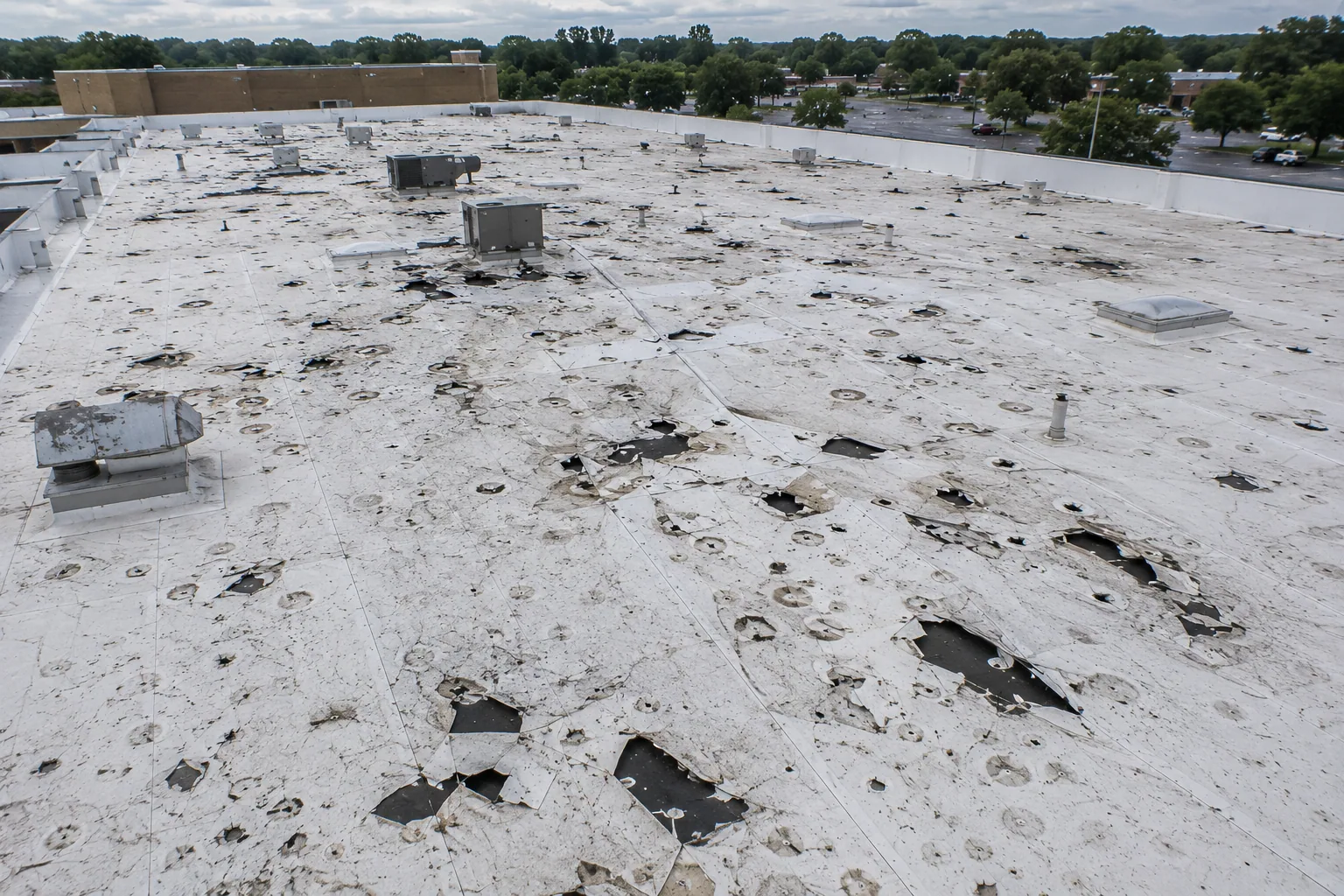
Tornado Damage Roof Repair in Pembroke Pines, FL
Tornado damage roof repair in Pembroke Pines, FL: structural clearance, debris mapping, load-path checks, emergency dry-in and phased rebuilding.
Tornado damage is close to binary at the scale of a roof section: the deck is either still connected to the building or it is not. A membrane that looks torn may sit on sound deck, while a roof that looks intact may have lost its connection to the wall below. For an owner in Pembroke Pines, FL, the first inspection finding is therefore structural. Tornadoes appear among the hazards of the stormiest weeks of the wet season, and the city's consolidated plan lists historical exposure to them next to flooding, heavy rain and hurricanes. That history is context. The roof in front of us supplies the facts, and we read them in an order that protects people first.
Clear the structure before the roof
No one should walk a tornado-damaged roof until a structural engineer or the building authority clears it. Deck may be loose, walls may be shifted and tie-downs may be pulled. Even a short visit can be dangerous.
We start with a drone survey and ground-level observation. We mark which areas are open to the sky, which are collapsing and which appear intact. The engineer sets the limits for access and tells us which sections need shoring before work begins. That clearance goes in writing to the owner and the carrier. Work that begins without it risks injury and complicates the claim.
Utilities come first on the safety list. Gas lines, electrical service and fire-protection systems may be damaged, and the utility or the building engineer confirms they are secured before any crew member steps onto the surface.
Map the debris path
Tornado debris is evidence. Pieces of other buildings, trees, signs and vehicles may lie across the roof, and their positions show how the storm moved. We photograph and map debris before moving it, then remove it in an order the engineer approves.
Debris also hides damage. Under a pile of broken material the membrane may be punctured, the deck cracked or the insulation soaked. After removal we walk the cleared area and mark each puncture and tear. A membrane puncture repair may be enough for some areas, while others need section replacement. The map separates them clearly.
Equipment on the roof may have been lifted, shifted or thrown. Its location, condition and connections are photographed before anything moves, because the carrier may ask where each item sat and how far it traveled.
Check the load path from roof to wall
A roof stays on a building through a chain of connections: membrane to insulation, insulation to deck, deck to supports, supports to walls. Tornado forces can break the chain anywhere. We check fasteners, welds, tie-downs and bearing points along the perimeter and at the walls.
Where the chain is broken, the engineer designs the repair, and the roofing scope follows. The city treats Exposure C as the default unless Exposure D applies under ASCE 7-22, so a repair that touches the structure or the attachment pattern is checked against those wind assumptions at permit review. We confirm the scope with the city and match the assembly to the required approvals.
A partial failure can be worse than a total one for planning. When part of a roof has lifted and settled back, the damage is hard to see, so pull tests and underside inspections matter more than the view from above.
Dry in what remains
Once the roof is cleared for work, the first job is to stop further water entry. Open areas are covered with tarps fastened through battens or with temporary membrane tied into sound sections. Drains are cleared, and loose edges are secured. Our emergency roof repair response is available at any hour.
The wet season runs from May 15 to October 15, with near-daily showers, so a temporary cover must withstand repeated rain. We photograph the roof before and after covering and keep receipts and a log. Interior spaces below are protected, and wet contents are moved. A short list closes the work: what was completed and which items stay open.
Contents and interiors need attention at once. Saturated drywall, ceiling tile and insulation come out and the space is dried within days, with moisture readings logged for the file.
Sound membrane outside the damaged zone is tested before it is reused. Pull tests, adhesion probes and moisture readings decide whether it stays, and the results go into the file beside the photographs.
Rebuild the edge and the attachment first
The perimeter is where the next storm will test the roof. We rebuild edge metal, coping and the first rows of attachment before the field, using details suited to the exposure. Fasteners, plates and adhesives match the required ratings.
Sound sections of membrane outside the damaged zone may be retained if attachment tests pass. Where they fail, the section is replaced. A wind damage repair scope covers the edges, and a tornado scope adds structural and debris elements. For major losses, the proposal is phased: dry-in, structure, moisture removal and the permanent roof.
Large losses may need cranes and heavy deliveries. Interstate 75 and US 27 are the main routes for materials reaching the area, and road conditions after a storm can delay them, so schedules include time for delivery.
The proposal for a large loss lists each phase with its own duration, so the owner can see how long the temporary cover must hold and what each step costs.
Document by section for the claim and the code
The file lists each roof section with its condition, the evidence, the engineer's findings, the repair performed and the photographs. Adjusters and restoration contractors work from it. A hurricane damage repair file follows the same order, so owners with buildings in Pembroke Pines and Miramar can compare events. The city enforces the Florida Building Code, 8th Edition (2023), and the permit documents belong in the same file.
Because tornado damage is often localized, adjacent buildings may be untouched. A record that compares the damaged roof with intact neighbors in Miramar or Hollywood is unnecessary for the claim but can help the owner decide how much of the surrounding portfolio needs inspection.
Commercial Roofing Questions
Is it safe to walk a roof after a tornado?
Not until an engineer or the building authority clears it. Deck may be loose, tie-downs may be pulled and walls may be shifted. We begin with drone imaging and ground observation, then enter the roof under the engineer's limits.
Why is debris left in place until it is mapped?
Debris shows how the storm moved and may hold damage underneath. Photographing and mapping it first preserves evidence for the carrier. Removal follows an order the engineer approves, and each cleared area is inspected for punctures and tears.
What does a load-path check involve?
We inspect fasteners, welds, tie-downs and bearing points from the membrane down to the walls. Broken connections are documented, and the engineer designs the repair. The roofing scope then follows the structural repair.
How can a damaged roof be protected until permanent repairs begin?
With fastened tarps or temporary membrane tied into sound sections, cleared drains and secured edges. In the wet season the cover must survive near-daily rain. We set a target date for permanent work when we install it.
Does the hurricane zone affect tornado repairs?
Yes. Anything beyond minor patching goes through permit review in this zone, and the products specified must carry approvals suited to the roof assembly. We confirm the scope with the city.