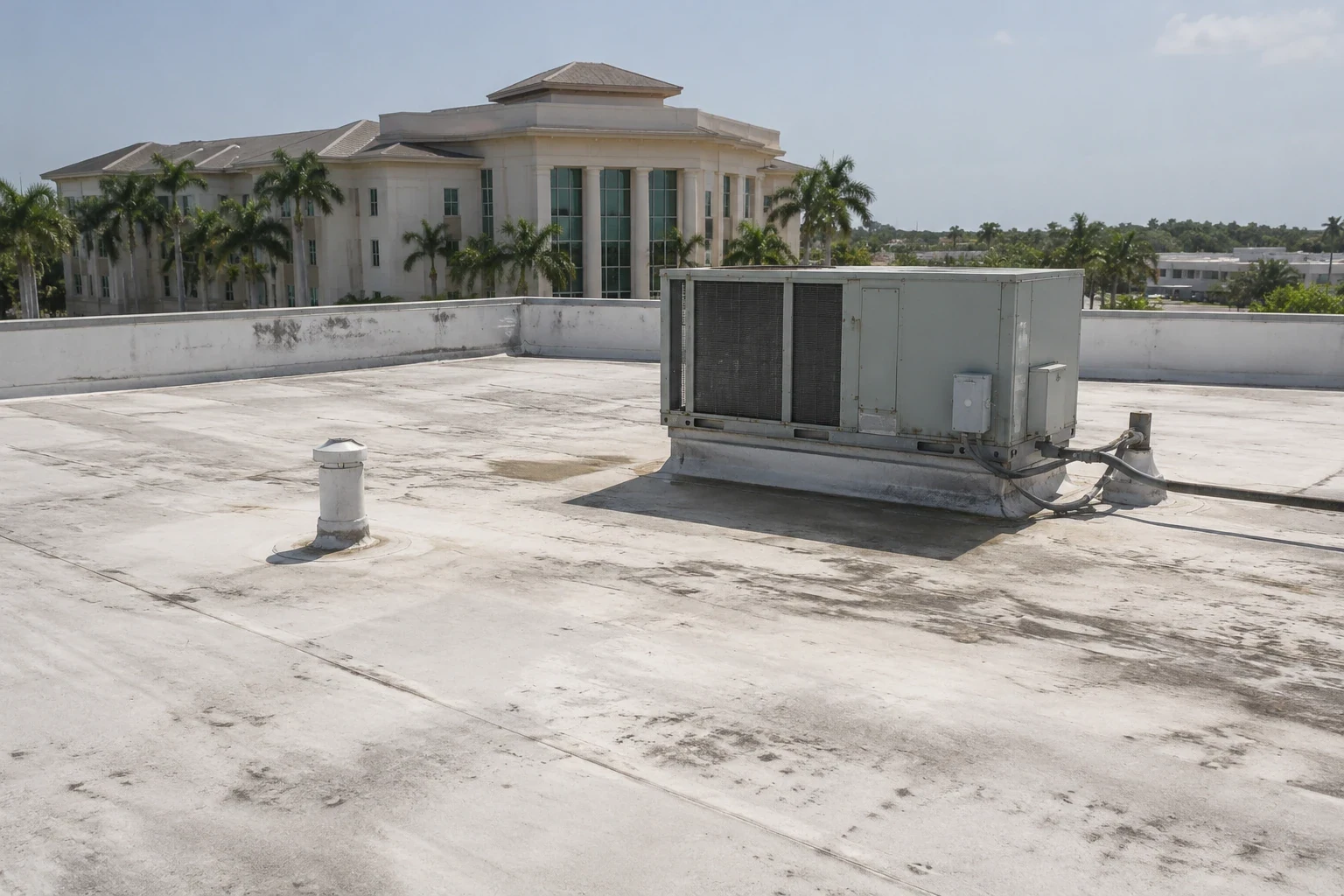
Commercial Roofing in Coconut Creek, FL
Commercial roof inspection, repair, and replacement planning in Coconut Creek, FL, from MainStreet retail and restaurant buildings to planned-community space.
A roof over a restaurant patio edge and a roof over a quiet office suite can be the same membrane and still need two different repair plans. Coconut Creek is a planned Broward County community with an emphasis on environmental design, and its MainStreet area combines retail and restaurant activity with planned housing and greenways. Planned projections are not completed buildings, so we treat every roof as an unknown until a walk says otherwise. For an asset manager in Coconut Creek, FL, the useful opening question is what sits under each section of roof: dining, retail, offices, or storage. The answer sets the order of repairs, the hours of access, and the protection that goes up first.
Start with what sits beneath each section
Before we plan a repair, we ask what happens under the open section. Dining rooms need protection from dust and noise, retail floors need clear entrances, and offices need quiet. A leak above a dining room has a different urgency than one over a storeroom, and the schedule should show.
On mixed-use roofs, we divide the plan into zones that follow the use below. Each zone gets a condition rating, a repair or replacement recommendation, and a work window that suits the occupants. For shopping center roofs with several tenants, this zone map also helps the landlord decide who bears the cost of each repair.
Zone maps also guide the sequence of protection. Over a dining space we install a ceiling-level barrier before any layer is cut, over retail we cover fixtures and merchandise, and over offices we protect desks and equipment. The protection stays until the roof above is dried in, and it is removed only after the crew confirms the area is tight. These steps take time, and we include them in the schedule from the start.
Retail tenants rotate, and each new fit-out may add vents, signage supports, or a cooler on the roof. A running list of additions, with dates and installers, lets the manager see which penetration came from whom. When a leak appears, that list turns an argument into a lookup.
Respect the design intent of a planned community
Planned communities and property associations can set review rules for appearance and noise, and roof work that adds visible equipment or changes parapet heights may fall under them. We ask about those requirements early, so submittals are ready before the schedule is fixed.
Greenways and landscaping near the buildings add another consideration. Debris, dust, and runoff from roofing work should not reach planted areas, and we place containment and protection accordingly. Where a building backs onto green space, the debris route is planned away from it, and cleanup is completed each day.
Lighting, signage, and solar are common additions in planned commercial areas, and each adds attachments. We review the proposed fastening method before installation and flash each penetration to suit the membrane, so a design change does not become a leak.
Keep dated figures in their place
The regional economic alliance reports 24,107 households in Coconut Creek using 2023 American Community Survey five-year estimates. The number is dated and describes households, not buildings. A leak that closes a shop or a restaurant affects the customers who use it, wherever they live, and that keeps the scheduling of access ahead of convenience.
MainStreet planning also describes projected buildout that should not be mistaken for completed construction. A roof in a newly built phase may have a different condition and warranty status from one in an earlier phase. Our warranty file review checks which documents apply to which section.
Phased construction leaves another trace on roofs: seams between phases. Where an older section meets a newer one, the membranes, flashings, and drainage may differ, and the junction is a likely leak point. We inspect those junctions closely and record the materials on both sides.
The distinction between planned and built matters for budgeting, too. A capital plan that counts projected buildings as existing roofs will overstate the portfolio, so the plan we prepare lists only roofs we have walked.
Plan openings around the afternoon pattern
Showers and thunderstorms can arrive almost every day from mid-May to mid-October, which is how the National Weather Service frames South Florida’s wet season, and the first weeks of it are the stormiest. Tropical systems then dominate the concern from August into October. Crews here plan each day around that pattern, opening only what can be sealed before the afternoon cells arrive.
Planning follows from that pattern. A section opens only if it can be sealed before the afternoon, with sheeting beside it and a lookout on duty. Should a system approach, the roof is closed up and work resumes after it passes.
Check edges where wind enters
Storm winds in the wet season can be damaging, and the first place they work is the roof edge. Coping, edge metal, and perimeter fasteners are tested by hand for play and rust. A loose run of edge metal can open the membrane beneath it, so edge metal and coping repairs are scheduled ahead of field repairs.
Wind-borne debris is the follow-on hazard, since loose gravel, tools, and offcuts become projectiles in a gust. The crew keeps the roof swept, weights down sheeting, and removes spare material at the close of each shift.
Pick the first work package
The walk sorts findings into leaks to stop now, repairs for this season, and roofs that will need capital. A commercial roof inspection documents all three, and a maintenance plan keeps small items from growing.
An owner with buildings in Margate or Lauderdale Lakes can fold them into a multi-site roof program and see which roof deserves the first slot.
Whatever the first package is, the report names the condition that decided it, so the owner can see why one roof moved ahead of another and what would change the order.
Commercial Roofing Questions
How do you protect a dining room during rooftop work?
We schedule noisy tasks outside service hours where possible, install interior protection over sensitive areas, and cover vents to keep dust out. The plan lists the dates and the sections affected, and the manager gets a contact for questions during work.
What if my building has a design review requirement?
Raise it at the start. If a repair adds visible equipment or changes edge details, the review may need drawings. We prepare the information the board requires and fit the roof schedule to the review calendar.
Can a newly built phase still need roof work?
Yes. New roofs can have installation defects, damaged flashing from other trades, or ponding from drain issues. An early inspection records the baseline and catches problems while they are still covered by contractor responsibility.
How do I know which warranty applies to which part of a building?
Gather the warranty documents and match them to the roof areas they cover. Older sections and additions often have separate documents. We map the coverage on a roof sketch so the owner can see which repair rules apply where. Where records are missing, we note it, since a gap in the file affects both the repair method and any later claim.
What does a maintenance visit include on a restaurant and retail roof?
We clear drains, check seams and flashings, inspect exhaust areas for grease, and photograph conditions. Small repairs are made on the spot, and larger items go on a list with a recommended timeline.