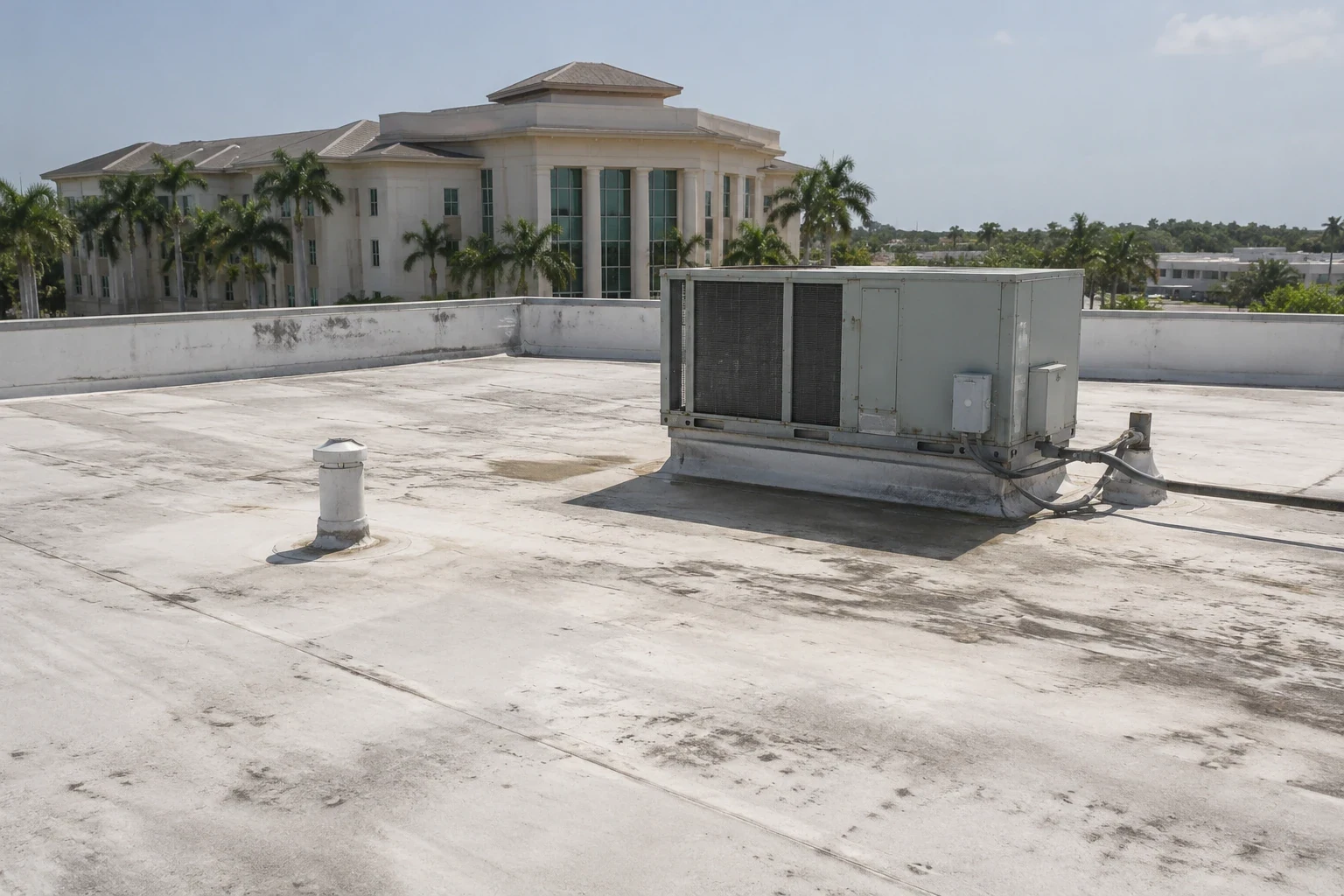
Roofing for Retail and Restaurant Chains in Pembroke Pines, FL
Roof inspection standards, store-by-store repair and multi-location programs for retail and restaurant brands with sites in Pembroke Pines, FL.
A chain rarely has one roof problem. It has the same curb detail, the same drain layout or the same exhaust arrangement failing across stores, and each failure looks isolated to the store manager who reports it. The first inspection finding that matters is the repeat: which detail keeps leaking, in which kind of building. For a retail or restaurant brand with a location in Pembroke Pines, FL, we compare the store's roof with the brand's other sites and with the local conditions that apply here. Pines Boulevard carries most of the city's commercial development, which puts many stores along one corridor, and wet-season storms limit how much any crew can open in a day.
Find the repeating detail
We start with the brand's maintenance tickets and repair invoices, sorted by store and by detail. A pattern shows up quickly: parapet scuppers that clog, rooftop unit curbs that leak at the same corner, vent boots that split at the same age. The pattern points to a design choice or a maintenance gap that a store-by-store response will never fix.
The remedy may be a standard detail, a change in the maintenance interval or a revised specification for the next roof. Whatever the answer, it applies to the whole brand, and the first store to be corrected becomes the model for the others. Curb and support upgrades are a frequent example, because a brand may install the same unit across many stores.
Small differences count. Two stores with the same plan can have different roof orientations, different tree cover and different units, so the repeat is confirmed on the roof and not assumed from the drawing.
Set one inspection standard
A chain needs inspection reports that compare. We use one format for every store: roof sections, findings, evidence, recommended action and cost range, with photographs tied to a plan. A regional manager can then sort stores by urgency and see what each needs.
The standard includes a moisture survey where leaks recur, because wet insulation changes the plan. It also records the roof's age, warranty status and prior repairs. Stores in a shopping center, a standalone pad or a big-box setting are noted separately, since the landlord may own the roof and the lease may assign repair duties. Shopping center and big-box stores each need a different conversation with the owner.
Tenant improvement work is a frequent trigger for roof damage. A pre-work and post-work walk around any rooftop change documents the roof for both landlord and tenant, and the record settles later questions about who caused a puncture.
Treat restaurants as their own case
Restaurant roofs carry grease, heat and moisture from kitchens. Exhaust fans discharge onto the membrane, and the material near them degrades faster than the field. We inspect around each fan, check containment pans and curbs, and recommend protective pads or compatible patches.
For a restaurant roof, the lease and the service contracts matter as much as the membrane. Who cleans the hood, who empties the pan and who may access the roof are all questions whose answers affect the roof's life. We put them in the report so the brand can fix the process, not just the roof.
Kitchens that vent through the roof share the same South Florida heat and humidity, so one grease-control standard can work across a brand's restaurants. The standard names the pan, the pad and the cleaning interval.
Keep the store trading
Stores earn money every day the doors are open. A roof plan therefore avoids opening hours, peak days and delivery windows for the loud and disruptive tasks. Work over entrances and customer areas is done early or late. Interior protection goes up before any section opens.
We ask for the store's blackout calendar, including holiday weeks and promotional events, and plan the work around it. Staging stays out of fire lanes and customer parking. For an occupied building, the schedule also names a contact who can stop work if a problem arises, so the store manager keeps control of the floor.
Holiday periods get special treatment. Roofs are inspected before the busiest weeks, so a leak does not appear during peak sales, and repairs that cannot finish in time are held with temporary protection.
Wind-driven rain in the wet season pushes water against parapets and wall flashings, so scuppers and counterflashing are checked before the stormiest weeks. A store that clears them in May rarely sees the first heavy storm turn into a work order.
Price the wet season and the wind code
Rain is routine from mid-May to mid-October, and the first stretch of that period is the roughest. Late-summer tropical systems add a further scheduling risk. A chain operating through those months needs roofs that are dry and secured.
A store reroof falls under the High Velocity Hurricane Zone and the 2023 code edition, with matching permit forms and approved products. The estimate carries standby time for weather and a permit scope checked with the city for every store, which keeps the number steady once the project starts.
Franchise structures add another layer. A franchisee may control the interior and the brand may control the standard, so the report states who is expected to act on each finding.
Two settings the city names matter to stores here. A unit on Pines Boulevard and one in an SW 145th Avenue office building have different access, parking and delivery traffic, so every store is planned individually.
Roll the findings into one program
A multi-site roof program lists each store, its roof rating, its next action and its budget year. The same record covers stores in Miramar, Weston and Davie as well as Pembroke Pines. Property management companies that own the buildings can work from it, and hospitality groups that run hotels beside the brand's stores can mirror the format.
Annual updates show the brand which stores moved up or down the ranking and why.
Brands that expand into new buildings can add them to the record on day one, which gives every new store a baseline from its first year.
Commercial Roofing Questions
How should a chain compare roof conditions across many stores?
Use one report format, rate each roof section on the same scale and sort stores by urgency. Include age, warranty status, repair history and moisture data. The format lets a regional manager see which store needs work first and why.
What can be done about the same roof leak recurring in different stores?
Treat it as a design or maintenance issue, not a series of separate repairs. Identify the detail, correct it at one store, and roll the standard out. Revise the maintenance interval if the cause is neglect.
Who is responsible for the roof when a store leases its space?
The lease decides. Some leases leave the roof to the landlord and some pass costs to the tenant. We record the findings and cost ranges so the brand and the landlord can discuss responsibility with facts.
Can a store stay open during roof work?
Usually, with work phased by section, early or late hours for loud tasks and interior protection above customer areas. The store manager keeps a contact who can stop work if a problem arises.
How does the hurricane zone affect a chain's reroofing in Pembroke Pines?
Permit paperwork and approved products are chosen for each store under the same code edition. The permit scope is checked with the city store by store, which keeps the chain's records complete.